What BRINC's $125 million actually buys a 911 agency
The public-safety manufacturer says the round will expand domestic production and new products, but routine remote response still depends on FAA authority, agency policy, dispatch, privacy, and measured outcomes.
By Joel Kelly

Decision brief
The funding is a market signal, not proof that every agency needs a dock. Buyers should evaluate operating authority, response-time gains, uptime, false deployments, staffing, data policy, community oversight, and total cost as one system.
- Round
- $125M
- Factory plan
- 3x
- Claimed agencies
- 900+
Led by Motorola Solutions
Company-stated size increase by year end
Public-safety customers reported by BRINC
Capital
The money buys production and distribution. Operating authority still has to be earned.
BRINC announced a $125 million financing round on July 14 led by Motorola Solutions, with participation from Index Ventures and Dylan Field. The company says the round takes its total capital raised above $250 million and will fund domestic manufacturing, new products, and commercial expansion.
BRINC also says it plans to move into a factory three times the size of its current facility by the end of 2026. Its announcement reports more than 900 public-safety agency customers, revenue that more than tripled in 2025, and monthly production capacity that increased fivefold. Those operating and growth figures are company claims, not independently audited performance results in this brief.
System view
A response drone only works when dispatch, policy, people, and aviation authority work with it.
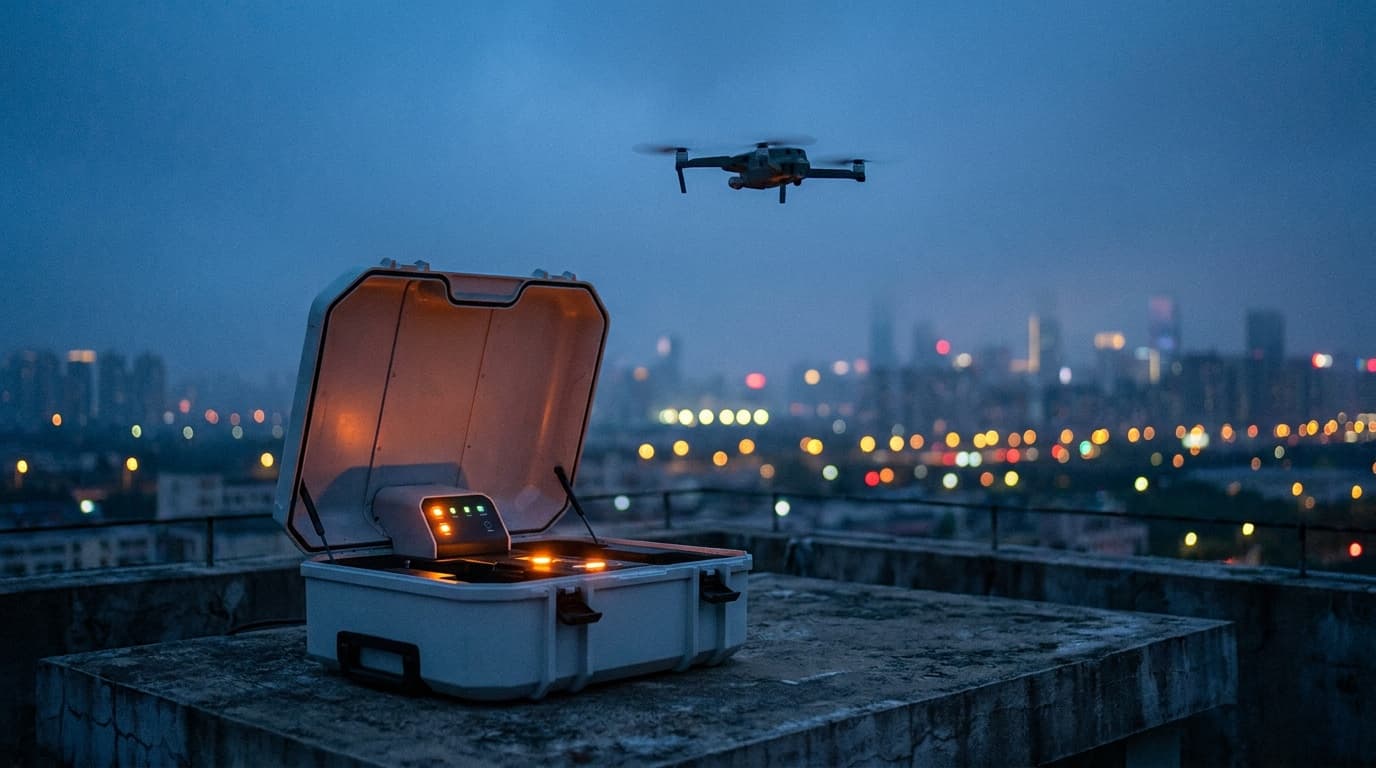
The capital is aimed at a category that is moving beyond a pilot carrying a drone in a vehicle. A drone-as-first-responder system links dispatch, remote oversight, a rooftop station, connectivity, weather limits, maintenance, evidence controls, privacy policy, and an FAA operating path. The aircraft is visible; the surrounding program is what makes repeated 911 response possible.
Routine beyond-visual-line-of-sight response is not unlocked by buying a dock. The FAA says public-safety operators must comply with Part 107 or their public-aircraft COA, and routine BVLOS requires the applicable waiver or COA provision. Agencies also need written deployment policy, community transparency, retention rules, cybersecurity review, crew proficiency, and a clear handoff when crewed aviation or incident command takes priority.
Jobs
Scale creates operations roles around the aircraft.
For the workforce, more deployed systems shift demand toward program managers, remote pilots, maintainers, trainers, dispatch integrators, data administrators, policy owners, and analysts who can measure outcomes. Useful metrics include time to scene, calls cleared without an officer response, uptime, aborted missions, weather cancellations, evidence quality, complaints, and the full cost per useful deployment.
Practical read
What an agency should test before calling a dock program successful
Strong fit
- Documented response-time and situational-awareness gaps
- An FAA path and accountable aviation-program owner
- Dispatch, IT, evidence, privacy, and community-review capacity
Account for
- Buying aircraft before defining call types and success metrics
- Treating a waiver, connectivity, weather, or staffing limit as a later detail
- Reporting flights and launch counts instead of useful public-safety outcomes
Source file
Verify the reporting
Continue on Drone Authority
Put the report to work
Continue this beat
More public safety reporting
Safety · September 9, 2026
St. Paul pulled its $200,000 drone grant the week Bellevue approved one and a Boston police drone landed on a car

Safety · August 28, 2026
Military says an Army laser defeated three hostile drones at the southern border
Safety · August 27, 2026