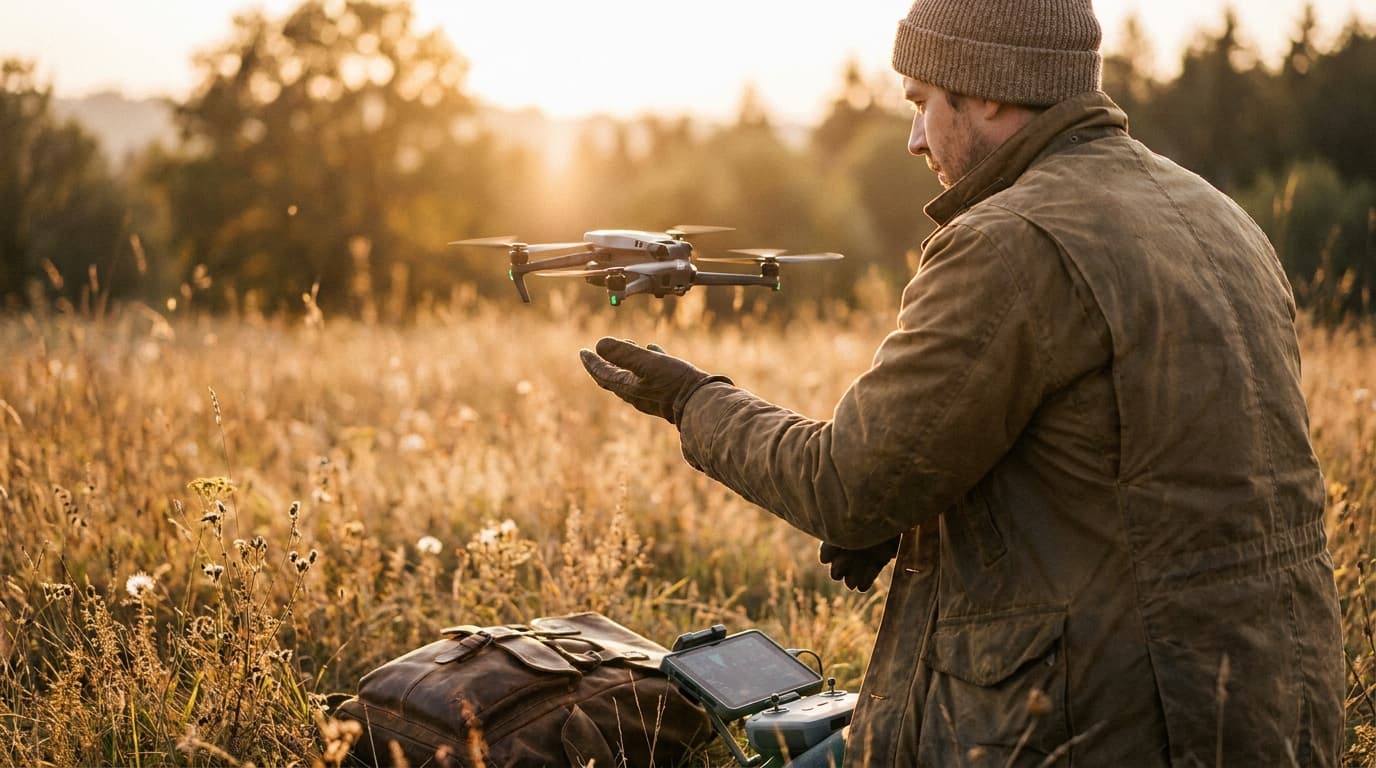
Why are you flying?
This is the question that decides everything. Any payment or business purpose, even an unpaid photo for your own listing or a monetized video, counts as commercial.
Educational, not legal advice. Rules current as of July 2026; verify before you fly at faa.gov/uas. Sources: FAA Part 107, the Recreational Flyers exception (Section 44809), FAA drone registration, and Remote ID rules.
The direct answer
One question decides it: is any money or business involved?
Flying for any business purpose or payment — client work, real-estate shots, inspections, monetized video — requires the FAA's Part 107 Remote Pilot Certificate: pass a $175 knowledge test at a PSI testing center, no flight test required. Flying purely for fun requires no license — just TRUST, the FAA's free online safety test you can't fail. Separately from either path, any drone 250 g (0.55 lb) or heavier must be registered for $5, and registered drones must broadcast Remote ID.
Recreational vs. Part 107 at a glance
| Recreational (TRUST) | Commercial (Part 107) | |
|---|---|---|
| Who it's for | Flying purely for fun — no business purpose, no payment, no monetized content | Any business or paid flying: client work, real estate, inspections, monetized video |
| Required credential | TRUST completion certificate (free online test, can't fail) | Remote Pilot Certificate — pass the $175 FAA knowledge test at a PSI center |
| Minimum age | None for TRUST | 16 to hold the certificate |
| Registration | $5 per pilot, only if any drone is 250 g or heavier | $5 per drone, every drone regardless of weight |
| Remote ID | Required only if the drone must be registered (250 g+) | Required (every Part 107 drone is registered) |
| Renewal | TRUST never expires | Free online recurrent training every 24 months |
Going the Part 107 route? Start with the free study hub and the free practice exam. Not sure about registration? Run the registration checker.
Common questions
Do I need a license to fly a drone?
If you fly for any business purpose or payment, you need an FAA Part 107 Remote Pilot Certificate. If you fly purely for fun, you don't need Part 107 — but you must pass TRUST, the FAA's free online recreational safety test. Drones 250 g or heavier must also be registered ($5, covers 3 years).
Is recreational drone flying the same as commercial?
No. Any payment or business purpose — including real-estate photos for your own listing, monetized YouTube video, or shots for a client who never pays you — counts as commercial and requires Part 107. Purely-for-fun flying qualifies for the recreational exception and only requires TRUST.
What is TRUST and how much does it cost?
TRUST (The Recreational UAS Safety Test) is the FAA's free online test for recreational flyers. You can't fail it: wrong answers show you the correct one and let you retry. It takes about 20-30 minutes through an FAA-approved test administrator, and you must carry proof of passage when you fly.
How do I get a Part 107 license?
Be at least 16, then pass the FAA Unmanned Aircraft General (UAG) knowledge test at a PSI testing center — the FAA's exam fee is $175, paid to PSI. No flight test and no flight hours are required. After passing, you apply for the Remote Pilot Certificate through the FAA's IACRA system.
Do I have to register a sub-250 g drone?
Not for recreational flying — drones under 250 g are exempt from recreational registration. But under Part 107, every drone must be registered regardless of weight. Registration is $5 per drone (Part 107) or $5 per pilot (recreational) and lasts 3 years.
Does my drone need Remote ID?
If your drone is required to be registered, it must broadcast Remote ID — either built in (standard Remote ID) or via an add-on broadcast module. A sub-250 g drone flown purely recreationally is not required to register, so it isn't required to have Remote ID either.
Verify with the FAA
Rules current as of July 2026. Educational, not legal advice — these are the primary sources this page is checked against: