On this page
What DFR actually is
Drone as First Responder inverts the traditional drone program. Instead of an officer driving to a scene and unpacking an aircraft, the aircraft is already positioned (on a rooftop, a trailer, or a substation) and launches the moment dispatch clears it. Typical arrival time is one to three minutes, almost always ahead of ground units. The drone's operator (often at dispatch, sometimes remote) streams live video to responding officers, who arrive knowing what they're walking into, or knowing they can stand down, which happens more often than people expect: a meaningful share of DFR flights clear calls without dispatching a unit at all.
The model was pioneered by Chula Vista PD in 2018 under the FAA's IPP program and stayed niche while every flight required bespoke approvals and human pilots on rooftops. Two things un-niched it: automated docks removed the rooftop pilot, and the FAA's waiver process matured from one-off experiments into a repeatable public-safety pathway. By 2026 the FAA is approving multi-drone supervision (a single remote pilot operating several docked aircraft simultaneously) for cohorts of agencies at a time.
Docks: the hardware backbone
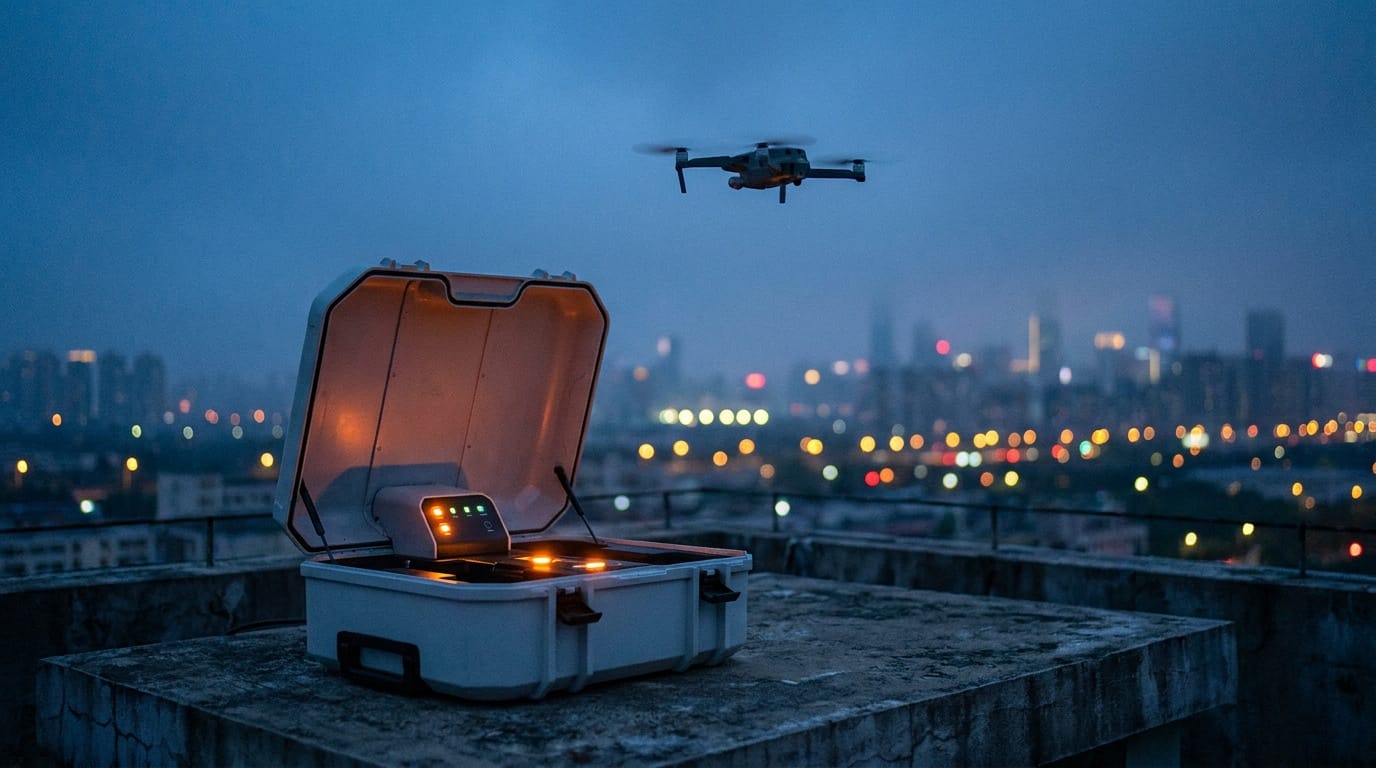
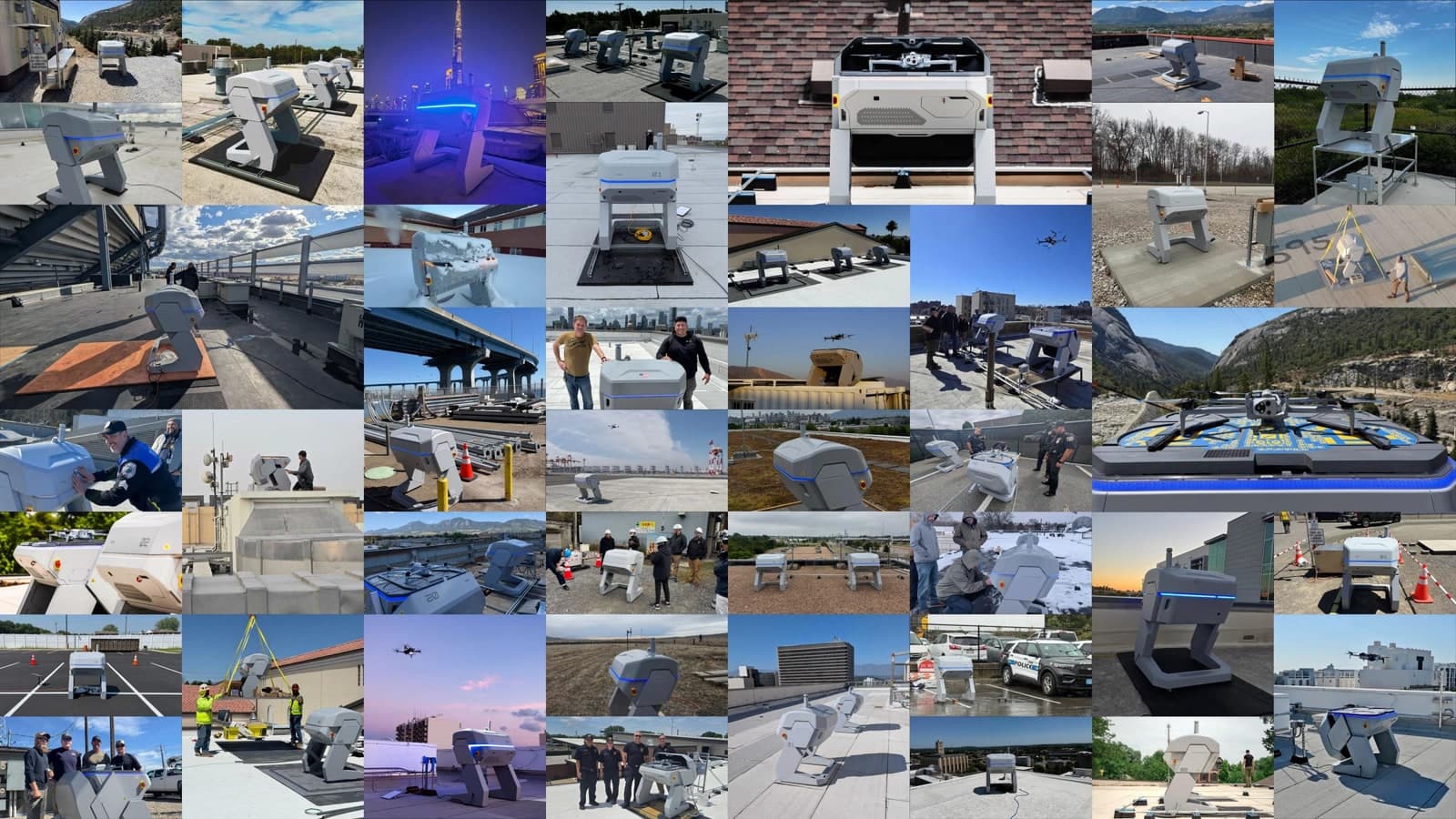
A dock (“drone in a box”) is a weatherproof station that shelters the aircraft, manages charging or battery swaps, runs pre-flight checks, opens, launches, recovers, and closes: on command from software, with no human at the site. Modern docks add climate control, backup power and connectivity, and integrated airspace awareness (ADS-B receivers, camera coverage of the launch area). A newer wrinkle: portable and trailer-mounted docks that deploy to events, disasters, or rotating hot spots without fixed power or internet.
Docks are what make DFR scale as infrastructure: coverage becomes a geometry problem (flight-time radius per dock, call density per sector) rather than a staffing problem. The same hardware pattern powers utility inspection, rail and port security, and construction monitoring, which is why the dock market is moving faster than any other segment of the industry.
The legal architecture: waivers and COAs
Everything distinctive about DFR (launching from a box the operator can't see, flying to a call across town) is beyond visual line of sight. BVLOS is prohibited by baseline Part 107, so every DFR program today flies on one of two legal foundations:
- •Part 107 waivers: most commonly waiving §107.31 (visual line of sight) and §107.33 (visual observer), supported by detect-and-avoid mitigations: ADS-B in, radar or acoustic sensing, altitude ceilings, shielded-operations concepts near structures, and strict operational procedures. The FAA has progressively standardized these for public safety, and 2026 approvals allow one remote pilot to supervise up to four docked aircraft across cohorts of departments at once.
- •Public aircraft operations under a COA: government agencies can operate as public aircraft under a Certificate of Waiver or Authorization, a distinct track with its own flexibility (including emergency provisions like SGI for exigent operations) and its own obligations. Many mature DFR programs run hybrid: COA for the agency mission, Part 107 waivers for specific capabilities.
The paperwork IS the program
Vendors sell docks; they can't sell you airspace authority. Budget the waiver/COA work (concept of operations, detect-and-avoid justification, training records, emergency procedures) as a first-class line item. Programs that treat approvals as an afterthought are the ones that stall at one dock.
What Part 108 changes (and when)
The FAA's proposed Part 108, the normalized BVLOS rule, was published as an NPRM in August 2025 and is the most consequential pending change in U.S. drone law. For DFR, it promises to replace the waiver treadmill with standing operating permissions and certified equipment categories: predictable approvals, multi-aircraft supervision as a rule rather than an exception, and a real regulatory home for docked autonomy. Two cautions. First, the final rule's timing and shape aren't settled: programs are being built on waivers now precisely so they're grandfathered into competence when 108 lands. Second, drafts tie BVLOS privileges to equipment and cybersecurity requirements that foreign-restricted hardware may never satisfy: one more reason the compliant-hardware question below isn't optional. For the full rule status, see our Part 108 tracker.
The 2026 dock landscape, honestly
The dock market splits cleanly along the compliance line we map in our NDAA / Blue UAS guide:
- •DJI Dock 3 + Matrice 4D/4TD: the global price-performance benchmark since March 2025: vehicle-mountable, fast-charging, superb aircraft. In the U.S. it's effectively fenced to programs without federal money in non-restriction states, and the FCC situation clouds new purchases. Widely deployed; increasingly hard to justify for American agencies.
- •Skydio (X10 + Dock): the default U.S. public-safety DFR stack: autonomy-first aircraft, the deepest bench of multi-drone BVLOS approvals, Blue UAS listed, federal-funds safe. Premium priced.
- •BRINC: DFR-native ecosystem (Responder aircraft + station) built specifically around 911 response, with dispatch integrations; U.S.-made and rising fast in agency adoption.
- •Flock Safety Aerodome: DFR as a service: dock, aircraft, software, and approval support bundled into the camera/LPR platform many agencies already run. The “nobody got fired for buying the platform” option.
- •Portable/trailer docks (e.g., DroneBooth-style deployables): the 2026 growth edge: dock coverage that moves to events, disasters, and rotating hot spots without fixed power or connectivity. Pair well with fixed sites rather than replacing them.
Evaluate the stack, not the drone
DFR procurement is a software-and-approvals decision wearing a hardware costume. Score vendors on dispatch integration, video latency to the responding officer's phone, multi-dock fleet software, evidence handling, and how much of the FAA approval burden they carry, before comparing camera specs.
Starting a program: the realistic sequence
- Map call density. One dock's coverage circle over your highest-volume sector is the pilot program; citywide coverage is a later phase, not day one.
- Decide the legal track. Public aircraft COA, Part 107 waivers, or hybrid: this choice shapes staffing, training, and which vendors' approval templates help you.
- Resolve the funding/compliance question first. Any federal grant money anywhere in the budget means compliant hardware, full stop. Check state law on top.
- Staff the remote operations seat. Certificated remote pilots with public-safety judgment are the scarce resource: our Part 107 training hub is the free on-ramp for officers studying for the exam.
- Publish your policy. The programs that survive community scrutiny publish flight logs, retention policies, and privacy rules proactively. Transparency is an operational requirement, not PR.
DFR: frequently asked questions
- What is a Drone as First Responder (DFR) program?
- A DFR program stations drones, increasingly in automated rooftop or trailer docks, around a jurisdiction so that when a 911 call drops, a drone launches immediately and arrives ahead of ground units, typically streaming video to dispatch and responding officers within one to three minutes. The model started with Chula Vista PD in 2018 and has spread to hundreds of agencies as dock hardware and FAA approvals matured.
- What is a drone-in-a-box or drone dock?
- A weatherproof enclosure that houses, charges (or battery-swaps), launches, and recovers a drone automatically, so the aircraft can fly missions from a fixed site with no on-scene pilot. Operators supervise remotely. Docks are what turn a drone program from 'a pilot drives out with a case' into standing infrastructure, and they're the hardware backbone of DFR, inspection, and security patrol programs.
- Is DFR legal? What FAA approvals does it need?
- Yes, under specific FAA authorizations. Because the remote operator usually can't see the aircraft, DFR flights are beyond visual line of sight (BVLOS), which today requires a Part 107 waiver (most commonly waiving the visual-observer and line-of-sight rules) or, for public agencies, operating as a public aircraft operation under a Certificate of Waiver or Authorization (COA). The FAA has been streamlining these for public safety, including 2026 approvals letting a single remote pilot supervise multiple docked drones, but every program flies on paperwork. The pending Part 108 rule is expected to normalize BVLOS without one-off waivers.
- Can police DFR programs still use DJI Dock 3?
- It's complicated, and the direction of travel is away from it. DJI Dock 3 (launched March 2025) is capable, widely deployed globally, and cheaper than U.S. alternatives, but DJI is on the FCC Covered List, federal funds (including grants) can't buy covered Chinese drones as of December 2025, and restriction states like Florida bar agency use outright. Agencies already operating DJI hardware can generally keep flying it where state law allows, but new federally-funded procurement effectively means Blue UAS-listed docks and aircraft. See our NDAA / Blue UAS guide for the compliant landscape.
- How much does a DFR program cost?
- Real-world 2026 budgets: roughly $30,000-$150,000+ per dock site for compliant hardware (aircraft + dock + integration), plus software/streaming subscriptions, FAA approval work, training, and staffing for remote operators. Chinese hardware runs meaningfully cheaper, which is exactly the tension agencies with federal grant money can no longer split. Most programs start with one or two docks covering the highest-call-volume sector and expand from coverage data.
- Do DFR drones need a visual observer?
- Under baseline Part 107 rules, yes, someone must keep the aircraft in sight. DFR programs obtain waivers replacing the visual observer with technical mitigations: aircraft detection (ADS-B in, acoustic or radar-based detect-and-avoid), altitude ceilings and shielded-operations concepts, camera coverage, and operational procedures. The 2026 generation of waivers increasingly permits one operator supervising several docked aircraft with no observers: the precedent Part 108 is expected to standardize.
Next steps
Open the guide or tool that matches the next decision.