Reference
Drone & FAA glossary
The acronyms come fast: Part 107, TRUST, LAANC, Remote ID, FRIA. Every term that actually matters to a U.S. pilot, defined in plain English.
 A–Z · GLOSSARY
Current as of June 2026. Rules change. Always verify current FAA rules at faa.gov/uas before you fly.
- AACS (Airman Certification Standards)
- The FAA document that lists every knowledge area the Part 107 exam can test, including airspace, weather, regulations, and drone operations. It is the official blueprint for what you must know to pass.
- Why it matters: Studying straight from the ACS tells you exactly what's fair game on the Remote Pilot knowledge test.
- AADM (Aeronautical Decision-Making)
- A structured way of thinking through the risks of a flight (weather, equipment, your own readiness, and the operating environment) before and during a mission. It's the FAA's framework for making safe go/no-go calls.
- Why it matters: ADM is tested on the Part 107 exam and is the habit that keeps a routine flight from turning into an incident.
- AAGL (Above Ground Level)
- An altitude measured from the ground directly beneath or near the aircraft/object, not from sea level. Part 107's 400-foot ceiling, Class E 700/1,200-foot floors, METAR cloud bases, and obstacle heights in parentheses are all AGL references.
- Why it matters: AGL follows the terrain, so a drone controller's height above takeoff is not automatically the same as legal height above changing ground.
- AAnti-Collision Lighting
- A light on the drone, visible for at least 3 statute miles and flashing at a rate that helps others see it, required for civil twilight and night operations under Part 107.
- Why it matters: Without a compliant anti-collision light you cannot legally fly at night, even after the night-operations rule change.
- BBroadcast Module
- An add-on device that attaches to a drone without built-in Remote ID and broadcasts the required identification and location data. It lets older drones comply with the Remote ID rule.
- Why it matters: If your drone isn't a 'standard Remote ID' model, a broadcast module is usually the cheapest path to legal flight outside a FRIA.
- BBVLOS (Beyond Visual Line of Sight)
- Flying a drone farther than the pilot or a visual observer can see it with unaided vision. Under current Part 107 it requires an FAA waiver; the proposed Part 108 rule would create a standardized framework for it.
- Why it matters: BVLOS unlocks deliveries, long infrastructure inspections, and mapping, which is why Part 108 is the most-watched rulemaking in the industry.
- CClass A Airspace
- Controlled airspace from 18,000 feet MSL up to 60,000 feet, used by high-altitude airliners and jets. It is far above where any small drone is permitted to fly.
- Why it matters: It's on the Part 107 exam, but a sub-400-foot drone will never legally reach it.
- CClass B Airspace
- Controlled airspace surrounding the busiest airports, shaped like an upside-down wedding cake. Drone flights here require prior FAA authorization, typically through LAANC.
- Why it matters: These are the highest-traffic, most tightly controlled airports, so authorization can be limited or require manual approval.
- CClass C Airspace
- Controlled airspace around medium-sized airports with a control tower and radar service. Drone operations require authorization, available instantly in many areas via LAANC.
- Why it matters: Most regional-city airports are Class C, so this is airspace hobby and commercial pilots commonly bump into.
- CClass D Airspace
- Controlled airspace around smaller airports that have an operating control tower, usually extending up to about 2,500 feet above the surface. Drone flights need authorization, often granted instantly through LAANC.
- Why it matters: Plenty of suburban airports are Class D, so checking before you fly there is routine.
- CClass E Airspace
- Controlled airspace that isn't A, B, C, or D. It often starts at the surface near airports without towers, or at 700 or 1,200 feet elsewhere. Drone authorization is only required where Class E reaches the surface.
- Why it matters: Class E that touches the ground around some non-towered airports still requires LAANC authorization, which surprises new pilots.
- CClass G Airspace
- Uncontrolled airspace, typically from the surface up to the base of overlying controlled airspace. Drone flights here need no air-traffic authorization.
- Why it matters: Most rural and suburban drone flying happens in Class G, where you can launch without LAANC approval.
- CCOA (Certificate of Waiver or Authorization)
- An FAA approval, used mainly by public agencies such as police and fire departments, that authorizes drone operations under tailored conditions. It's a government-operator equivalent to a Part 107 waiver.
- Why it matters: Public-safety and government agencies often fly under a COA rather than standard Part 107 rules.
- CControlled vs. Uncontrolled Airspace
- Controlled airspace (Classes A–E) is managed by air traffic control and requires drone authorization near airports; uncontrolled airspace (Class G) does not. The distinction decides whether you need LAANC before you fly.
- Why it matters: It's the single most important airspace question: do I need authorization here, or can I just launch?
- FFAADroneZone
- The FAA's official online portal for registering drones, managing registrations, and applying for certain waivers and authorizations. Recreational and Part 107 registration both happen here.
- Why it matters: It's the one official site for the $5 drone registration; avoid third-party lookalikes that charge more.
- FFPV (First-Person View)
- Flying a drone using a live video feed from an onboard camera, usually through goggles, as if you were sitting in the cockpit. Because the goggles block your direct view, a visual observer is required to keep the drone within visual line of sight.
- Why it matters: FPV is legal only if someone maintains unaided visual line of sight on the aircraft the whole time.
- FFRIA (FAA-Recognized Identification Area)
- A defined geographic area, often sponsored by a flying club or school, where drones without Remote ID may legally fly as long as they stay within visual line of sight. It's the carve-out for drones that can't broadcast Remote ID.
- Why it matters: If your drone has no Remote ID and no broadcast module, a FRIA is the only place you can legally fly it.
- GGeofencing
- Manufacturer software that uses GPS to warn pilots about, or block flight in, sensitive areas like airports. It is a feature of the drone, not an FAA regulation, so it doesn't replace your legal responsibility to check airspace.
- Why it matters: Geofencing can be disabled or absent, so it's a backstop, not proof a flight is legal.
- IIACRA (Integrated Airman Certification and Rating Application)
- The FAA's online system for applying for airman certificates, including the Part 107 Remote Pilot Certificate. You complete the application here after passing the knowledge test.
- Why it matters: After you pass the exam, IACRA is where you file to actually receive your remote pilot certificate.
- LLAANC (Low Altitude Authorization and Notification Capability)
- An automated system that gives drone pilots near-instant authorization to fly in controlled airspace near many airports. You request it through an FAA-approved app rather than calling a control tower.
- Why it matters: LAANC turns what used to be a multi-day waiver request into an approval you get in seconds on your phone.
- MMSL (Mean Sea Level)
- An altitude measured from average sea level rather than from the ground beneath the aircraft. Airport elevations, terrain elevations, MEF, obstacle top elevations, and most sectional airspace shelf labels are given in feet MSL unless the chart says otherwise.
- Why it matters: MSL is the chart's fixed reference; you compare it with local ground elevation when you need to understand real height above terrain.
- MMTOW (Maximum Takeoff Weight)
- The heaviest a drone is allowed to be at takeoff, including batteries and any payload. Under Part 107 a small drone must weigh less than 55 pounds at takeoff.
- Why it matters: Adding cameras or cargo can push a drone past weight thresholds that change which rules apply.
- NNight Operations
- Flying after the end of evening civil twilight and before the start of morning civil twilight. Part 107 pilots may fly at night without a waiver if the drone has anti-collision lighting visible for 3 statute miles and the pilot has completed updated recurrent training.
- Why it matters: Night flying is now routine rather than waiver-only, provided your lighting and training are current.
- NNOTAM (Notice to Air Missions)
- An official notice about temporary conditions affecting flight safety, such as airspace closures, hazards, or special events. Pilots are expected to check relevant NOTAMs before flying.
- Why it matters: A NOTAM can quietly close the airspace you planned to fly, so checking is part of preflight.
- OOperation Over People (Categories 1–4)
- Part 107 rules that permit flying directly over people only if the drone meets one of four safety categories based on injury risk, driven mainly by weight and whether the drone has exposed rotating parts. Heavier or higher-risk drones require more stringent compliance.
- Why it matters: Most aerial work over crowds or moving vehicles is illegal unless your drone qualifies under one of these four categories.
- PPart 107
- The FAA regulation governing commercial and other non-recreational small drone operations in the United States. It sets the rules for who can fly for work and how, and requires a Remote Pilot Certificate.
- Why it matters: If you fly for any business or compensation, Part 107 is the rulebook you operate under.
- PPart 108
- A proposed FAA rule that would create a standardized framework for routine beyond-visual-line-of-sight (BVLOS) drone operations. As of June 2026 it is still in rulemaking: the proposed rule was published in 2025 and a final rule has not taken effect.
- Why it matters: Part 108 is expected to replace today's case-by-case BVLOS waivers and unlock delivery and long-range inspection at scale.
- PPSI Testing Center
- An FAA-approved knowledge testing center, operated by the vendor PSI, where you take the in-person Part 107 Remote Pilot exam. You schedule a seat at one of these centers to sit the test.
- Why it matters: The initial Part 107 knowledge test must be taken in person at a PSI center; it isn't an at-home online exam.
- RRecurrent Training (ALC-677)
- The free online FAA course (catalog number ALC-677) that Part 107 pilots complete every 24 calendar months to stay current. It covers updated rules on Remote ID, night operations, and operations over people.
- Why it matters: Completing ALC-677 on time keeps your remote pilot privileges valid and is required before flying at night.
- RRegistration
- Listing your drone with the FAA through FAADroneZone for $5 per drone, valid for 3 years. Recreational flyers must register drones 250 grams and heavier; under Part 107 every drone must be registered regardless of weight.
- Why it matters: Flying an unregistered drone that requires registration can carry significant civil and criminal penalties.
- RRemote ID
- A requirement that most drones broadcast identification and location information during flight, functioning like a digital license plate. Any drone that must be registered must also meet Remote ID rules.
- Why it matters: Remote ID compliance is mandatory; pilots without it can fly only inside a FRIA.
- RRemote Pilot Certificate
- The FAA certificate that authorizes a person to operate small drones under Part 107. You earn it by passing the Remote Pilot knowledge test and applying through IACRA.
- Why it matters: It's the credential that legally lets you fly drones for business or compensation.
- RRTH (Return to Home)
- A drone feature that automatically flies the aircraft back to its takeoff point, usually triggered by low battery, lost signal, or a pilot command. It's a safety function, not a substitute for active piloting.
- Why it matters: RTH can save a drone after signal loss, but obstacles in its return path can still cause a crash.
- SSection 44809
- The federal statute that grants the recreational drone exception, letting hobbyists fly without a Part 107 certificate if they follow specific conditions. Those conditions include passing TRUST, staying within visual line of sight, and flying strictly for fun.
- Why it matters: It's the legal basis for flying recreationally; break its conditions and you fall under Part 107 instead.
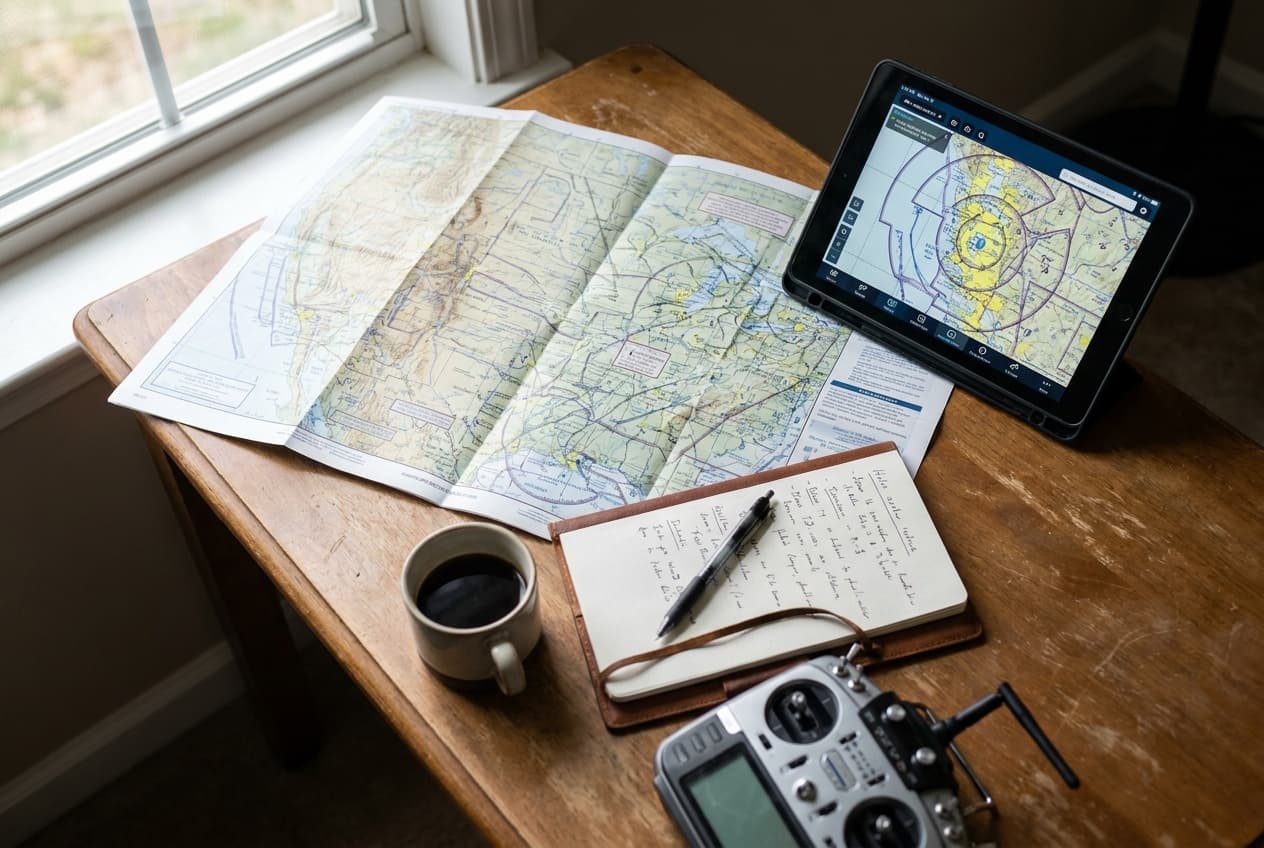
- SSectional Chart
- A detailed aeronautical map showing airspace classes, airports, terrain, and obstacles. Drone pilots use it (or apps based on it) to identify airspace and hazards before flying.
- Why it matters: Reading a sectional chart is a tested Part 107 skill and the basis for knowing which airspace you're in.
- SStandard Remote ID
- A drone with Remote ID built in by the manufacturer, broadcasting required identification and location data directly from the aircraft. It's distinct from adding a separate broadcast module to a non-Remote-ID drone.
- Why it matters: Buying a standard Remote ID drone means one less device to attach and manage for legal flight.
- SsUAS / UAS
- UAS stands for Unmanned Aircraft System: the drone plus its controller and supporting equipment. sUAS is the 'small' subset, meaning the aircraft weighs less than 55 pounds, which is the category Part 107 covers.
- Why it matters: Nearly every consumer and prosumer drone is an sUAS, so it's the FAA term that applies to you.
- SSub-250g
- A drone weighing less than 250 grams at takeoff. Recreational flyers don't have to register drones under this weight, which is why many beginner and travel drones are built to just clear it.
- Why it matters: Sub-250g drones skip recreational registration, but commercial Part 107 use still requires registration.
- TTFR (Temporary Flight Restriction)
- A short-term restriction that closes off airspace for reasons like VIP movement, major sporting events, wildfires, or disasters. Flying a drone inside an active TFR is prohibited.
- Why it matters: TFRs pop up with little notice and carry serious penalties, so checking for them is a must before every flight.
- TTRUST (The Recreational UAS Safety Test)
- A free online test recreational drone pilots must pass to fly legally under the recreational exception. It covers basic safety and rules, takes minutes, and produces a completion certificate you should carry while flying.
- Why it matters: If you fly purely for fun, TRUST is the one credential the FAA requires, and it's free.
- VVisual Observer
- A person who helps the remote pilot keep the drone within visual line of sight and scan for hazards, staying in communication with the pilot. They're commonly used in FPV flying and larger operations.
- Why it matters: A visual observer is what makes goggles-based FPV flying legal under the VLOS requirement.
- VVLOS (Visual Line of Sight)
- The requirement that the pilot, or a visual observer in contact with the pilot, can see the drone with unaided vision throughout the flight. Binoculars and onboard cameras don't count toward maintaining it.
- Why it matters: VLOS is a core limit of routine drone flight; going beyond it requires a waiver or, eventually, Part 108.
- WWaiver
- FAA permission to deviate from certain Part 107 rules (such as flying beyond line of sight or over people) when you can show the operation will still be safe. You apply through the FAA and must justify your safety case.
- Why it matters: Waivers are how pilots legally do things Part 107 otherwise prohibits, but approval can take time and isn't guaranteed.
A
B
C
F
G
I
L
M
N
O
P
R
S
T
V
W
Don't see a term? Drone rules evolve constantly; verify anything you're relying on at faa.gov/uas.