Amazon names 11 live drone sites. Its 500-city target still needs an address check.
Amazon's new location list establishes a real baseline across 10 metros. The year-end target and Uber-Zipline volume goal still describe future reach rather than current address eligibility.
By Joel Kelly
More onDrone delivery
What changed: Updated August 22 after Amazon published its current 11-site list, planned launch metros, address-check instructions, item limits, and delivery fees.

Decision brief
Amazon now provides a useful current denominator: 11 active sites across 10 U.S. metro areas. A listed metro still is not an address guarantee, and Uber and Zipline's 2029 daily target remains a future goal rather than present volume.
- Amazon live baseline
- 11 sites
- Amazon reach plan
- Nearly 500
- Uber + Zipline target
- 1M/day
Across 10 U.S. metro areas
U.S. cities and towns by year-end
By the end of 2029
Amazon's denominator
Eleven active sites are the baseline. Five hundred city names are the target.
Amazon announced on August 19 that Prime Air plans to reach nearly 500 U.S. cities and towns by the end of 2026. It also published the current denominator: 11 active sites across 10 metro areas. The sites are Tolleson near Phoenix; Ruskin near Tampa; Kansas City; Papillion near Omaha; Baton Rouge; Hazel Park and Pontiac near Detroit; Richmond near Houston; San Antonio; Richardson near Dallas; and Waco.
Amazon names Chicago, Syracuse, Cleveland, Atlanta, and Boise as coming soon. For an eligible customer, the company says nearly all items weighing five pounds or less and fitting in a large shoebox can qualify, with delivery in as little as 30 minutes. Prime members currently pay no drone-delivery fee on orders of $50 or more, $2.99 below $50, and non-Prime customers pay $4.99. The exact address and item still have to pass checkout.
The current site list makes the scale claim easier to read without turning it into a service map. Amazon says each site serves approximately 175 square miles, while listed ZIP codes can contain addresses that are not eligible. FAA environmental records describe potential operating envelopes and daily ceilings, but actual customer service still depends on installed sites, suitable delivery points, inventory, demand, weather, and the released checkout flow.
Uber's distribution layer
The app partnership could create demand faster than the flight network grows.
Two days before Amazon's announcement, Uber said it was making a strategic investment in Zipline and integrating Zipline delivery into Uber Eats. Axios reports that the service is expected to start in Houston and Dallas before the end of 2026, then expand to dozens of U.S. cities. The companies set a target of one million Uber Eats drone deliveries per day by the end of 2029 and did not disclose the investment terms.
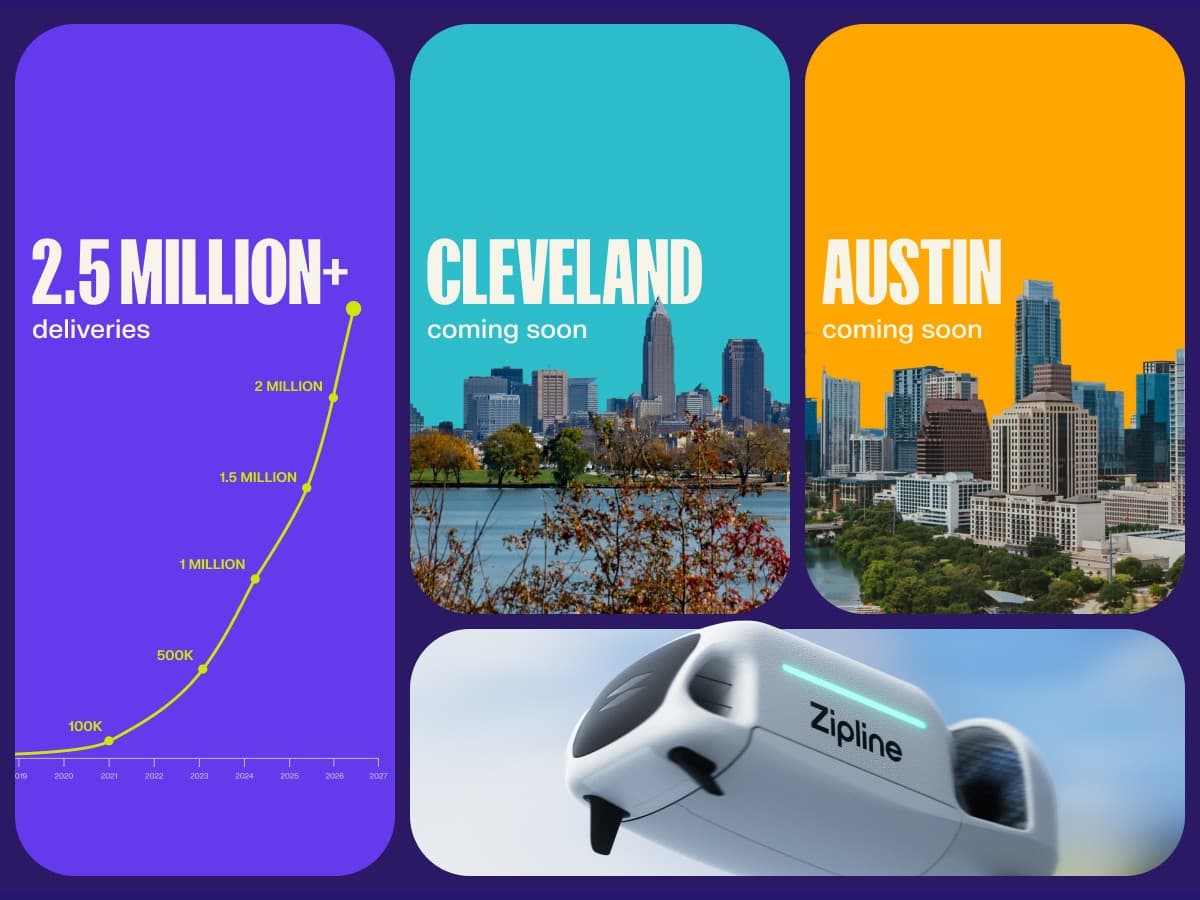
That target is much larger than Zipline's current public baseline. Zipline reported in July that it had completed more than 2.5 million commercial deliveries in total, including one million in the prior year, with roughly 70 percent of its flights occurring in the United States. The existing network shows that the system can carry real orders; it does not make the 2029 rate a present-day operating figure.
Expansion check
How to read a drone-delivery announcement
Keep the headline number, the authorized network, and the live customer experience in separate columns.
- 01
Name the target
Record whether the number refers to cities, customers, stores, sites, addresses, flights, or completed deliveries.
- 02
Find the operating sites
Check which facilities are approved, which are proposed, and which are already accepting customer orders.
- 03
Read the operating envelope
Range, payload, hours, weather, delivery-point rules, and daily ceilings define what the network can attempt.
- 04
Watch completed service
Eligible addresses, daily deliveries, availability, repeat use, and exception handling show what customers actually receive.
What changes now
The useful evidence begins after the announcement.
For customers, the immediate change is another delivery option at checkout where an address qualifies. For pilots, neither announcement creates ordinary gig routes that a Part 107 certificate alone authorizes. The FAA uses Part 135 air-carrier certification for compensated package delivery beyond visual line of sight, supported by approved aircraft, operating specifications, personnel, maintenance, dispatch, and site procedures.
The proof to watch is now operational: how many sites are approved and active, how many addresses can place an order, how often weather or unsuitable drop zones block service, what customers pay, how many deliveries are completed each day, and whether people order again after the novelty wears off. Those measures will show whether this week's large reach targets become a dependable logistics network.
Source file
Verify the reporting
- Amazon: Current Prime Air locations, planned metros, eligibility, and fees
- Associated Press: Amazon plans drone delivery expansion to nearly 500 U.S. cities and towns
- Amazon: 2025 letter to shareholders
- FAA: Environmental reviews and operating details for drone delivery sites
- Axios: Uber and Zipline target one million Uber Eats drone deliveries per day
- Zipline: 2.5 million deliveries and U.S. expansion baseline
- FAA: Package delivery by drone under Part 135
Continue on Drone Authority
Put the report to work
Continue this beat
More commercial reporting
Industry · July 15, 2026
Amazon's Chicago plan tops out at 3,000 drone flights a day, and the comment window has closed
Industry · July 26, 2026
Zipline's 2.5 millionth delivery is the wrong number to watch
Industry · July 31, 2026