
Aircraft and application kit
The airframe, tank or hopper, pumps, atomizers or spreading hardware, radar and vision systems, controller, and route-planning software must be quoted as one compatible configuration.
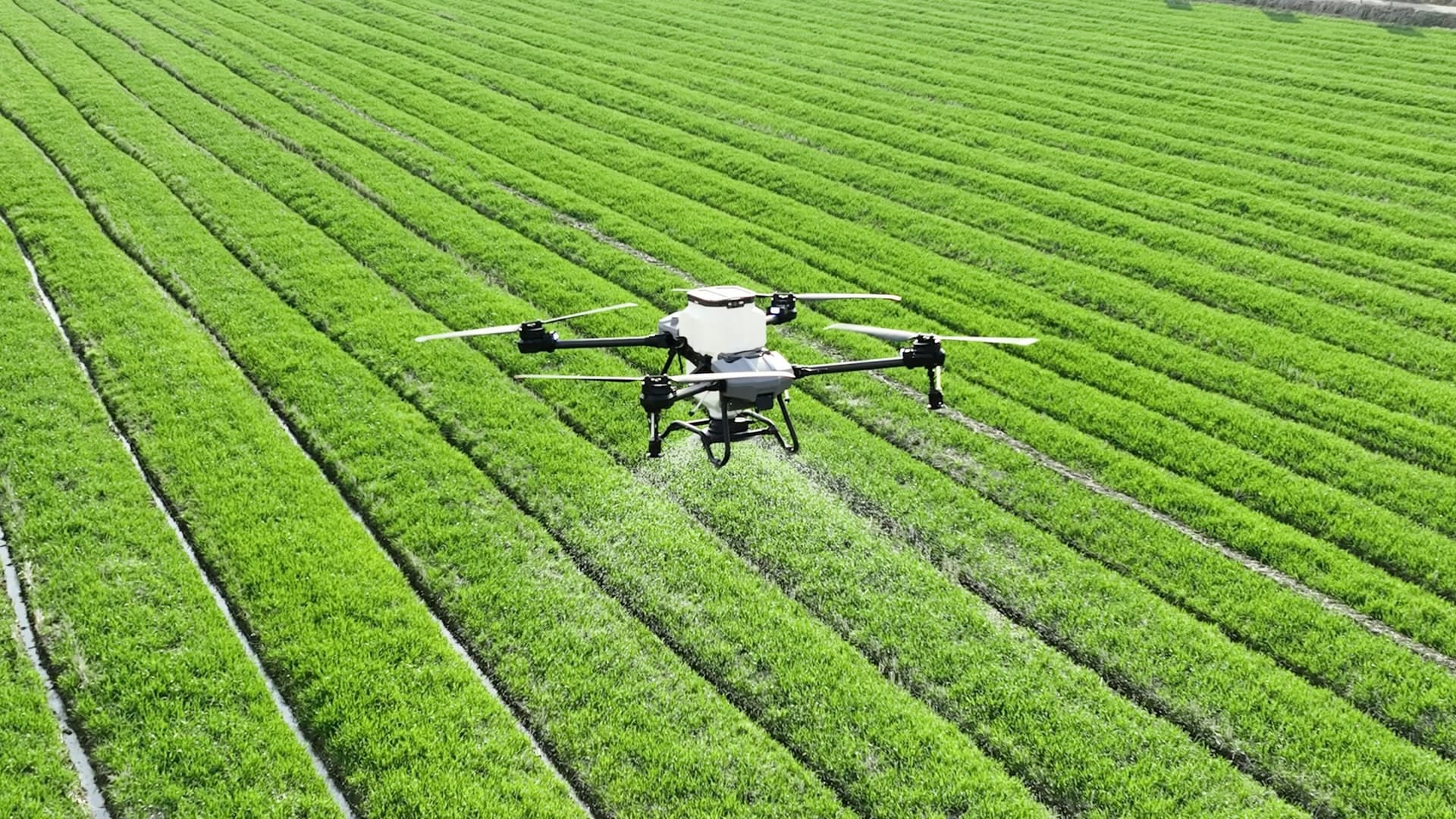
Aircraft dossier / Manufacturer claims separated from operating analysis
Large agricultural application system
The T50 is a dealer-supported spray and spread platform, not a large camera drone. Its published capacity only becomes useful when the operator can support the legal approvals, mixing and refill workflow, charging power, calibration, transport, maintenance, and seasonal service response around it.
Product image: Official DJI Agriculture product image
Decision brief
Best fit: Established custom applicators, co-ops, growers, and dealer-supported programs with enough acreage and field logistics to keep a high-capacity aircraft productive.
Published configuration
These are manufacturer-published specifications, not independent field measurements. The context matters as much as the number.
DJI maximum at sea level. Payload is derated with altitude and operating conditions.
Published internal load and tank volume for compatible dry granules.
Two-sprinkler maximum. DJI lists up to 24 L/min with the optional four-sprinkler configuration.
Published full-charge time for the DB1560 battery under DJI test conditions and qualifying power infrastructure.
DJI test range at 3 m above crops. Coverage uniformity, material, droplet target, and conditions control the usable swath.
Published sea-level maximums. This places normal loaded operations outside Part 107's under-55 lb aircraft lane.
Operating system
Dealer or program purchase. Confirm the exact aircraft, spray or spread kit, battery count, charger or generator, controller, relay, training, warranty, parts, seasonal service, and approval support in the written quote.
The airframe, tank or hopper, pumps, atomizers or spreading hardware, radar and vision systems, controller, and route-planning software must be quoted as one compatible configuration.
A 9-12 minute laboratory charging claim is not field throughput by itself. Generator output, fuel, battery temperature, cooling, refill time, water and material handling, transport, and crew rhythm determine the real cycle.
Nozzles, pumps, hoses, seals, motors, batteries, calibration, firmware, and crash repair can stop an operation during a narrow crop window. Get service response and loaner expectations in writing.
The operation still needs the correct field, product, label, rate, buffer, weather, calibration, pilot, aircraft, and application record. The flight log is not the whole application record.
Operating fit
The capacity can reduce refill frequency where field geometry, legal authority, tender access, crop height, obstacles, and application parameters support a productive route.
Terrain follow, atomized application, and route planning can support complex crops, but wires, guy wires, vegetation, lighting, radar limits, and emergency landing space still need a field-specific plan.
Spreading throughput depends on material diameter, density, moisture, hopper gate, spinner speed, target rate, and distribution verification. The 50 kg capacity is not a universal application rate.
United States
This is an educational overview. Confirm the current aircraft, operation, exemptions, certificates, state credentials, labels, airspace, and local conditions before operating.
Dispensing an economic poison or material for plant nourishment, soil treatment, propagation, pest control, agriculture, horticulture, or forest preservation can trigger Part 137.
A normally loaded T50 exceeds 55 lb. Large agricultural UAS commonly require an exemption path, N-number registration, Part 91 operating conditions, and the authority named in the operator's exemption and certificate.
FAA approval does not replace state aerial applicator licensing, pesticide-category credentials, product-label compliance, records, drift requirements, insurance, or local restrictions.
Airspace, visual line of sight, people, roads, crew roles, weather, material handling, and every exemption or certificate condition still govern the actual field operation.
Field cycle
Confirm the operator certificate, aircraft authority, registrations, pilot and applicator credentials, state rules, product label, insurance, airspace, and landowner scope.
Verify field boundaries, target rate, material, buffers, obstacles, route, droplet or granule settings, wind, temperature, tender location, emergency areas, and calibration evidence.
Separate chemical handling from aircraft handling, control refill and battery sequence, inspect application hardware, manage contaminated equipment, and stop when the approved envelope changes.
Reconcile acreage, amount loaded and applied, weather, route deviations, operator, aircraft, product and label, calibration, incidents, maintenance findings, and required state records.
Before requesting a quote
Sources
DJI Agriculture
Product positioning, payload claims, flow claims, transmission, and procurement channel.
DJI Agriculture
Weights, payloads, tank volumes, swath, pumps, batteries, charging, and environmental caveats.
DJI Agriculture
Obstacle-system conditions, droplet controls, spreading constraints, relay use, and charging requirements.
Federal Aviation Administration
Part 137 triggers and the current UAS agricultural certification process.