Senate bill would let the National Guard take down drones at major events when a state asks
Sen. Mike Lee introduced the Guard the Skies Act, S. 5716, on November 11. It would let the Secretary of Defense authorize Guard members to use the federal counter-drone powers at special events and mass gatherings. The House version, H.R. 8697, has been in committee since May.
By Joel Kelly

Decision brief
This is a bill in committee, not law. If it passes, National Guard members could join federal agents and trained local police as people allowed to detect, seize, or disable a drone at a major event or mass gathering, once a state asks. If you fly near big events, check the drone TFR tracker before you launch.
- Bill
- S. 5716
- Status
- In committee
- House version
- H.R. 8697
Guard the Skies Act, introduced November 11, 2026, by Sen. Mike Lee
Referred to Senate Armed Services; no cosponsors listed
Introduced May 7, 2026; no action since referral
The bill
A new section 130j for the National Guard.
Sen. Mike Lee, a Utah Republican, introduced the Guard the Skies Act, S. 5716, on November 11. It was read twice and referred to the Senate Armed Services Committee, and congress.gov lists no cosponsors. The bill would add a new section, 10 U.S.C. 130j, letting the Secretary of Defense authorize National Guard members to use the counter-drone powers that federal law now gives the Departments of Homeland Security and Justice. The Secretary could act only at the request of a state's chief executive officer.
What the Guard could do
The same powers DHS and Justice have, for three kinds of missions.
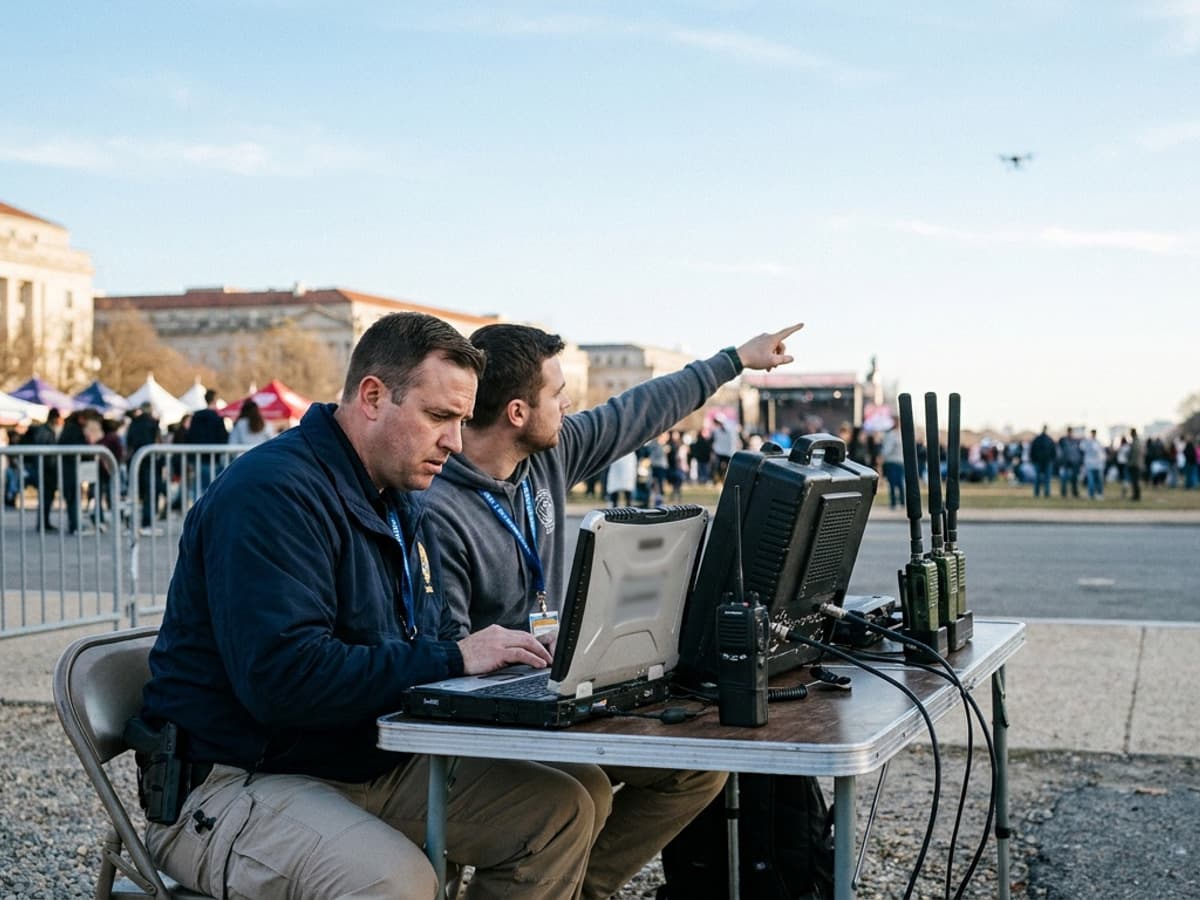
Those powers come from 6 U.S.C. 124n. They run from detecting, identifying, and tracking a drone, including by intercepting its control signals, to warning the operator, disrupting control, seizing the aircraft, and using reasonable force, if necessary, to disable, damage, or destroy it. The Guard could use them only for three kinds of missions the law lists: protecting a National Special Security Event or Special Event Assessment Rating event, supporting state or local police at mass gatherings for a set time and place, and protecting an active federal investigation, emergency response, or security function for a set time and place. Guard members would have to be ordered to duty under title 10 or title 32 and assigned the duties described in 10 U.S.C. 130i, the Defense Department's own counter-drone law.
Coordination
The Secretary of Defense joins the FAA in the loop.
The bill also brings the Secretary of Defense into coordination the law already requires. Today DHS and Justice must coordinate with the FAA when a counter-drone action might affect aviation safety, civilian aviation, aircraft airworthiness, or the use of the airspace. For actions a state requests under the new section, the bill adds the Secretary of Defense to that list. It would also add these actions to 10 U.S.C. 12304(b), which covers ordering reserve members to active duty other than during war or national emergency, and add support of them to 32 U.S.C. 502(f)(2).
The House version
The same text has sat in the House since May.
The Senate text carries the same provisions as H.R. 8697, which Rep. Michael McCaul introduced on May 7 with five original cosponsors. That bill was referred to three House committees and shows no action since. McCaul's release that day says the Safer Skies Act, passed in the fiscal 2026 defense authorization act, "was an essential first step" in giving state, local, tribal, and territorial police the authority to counter rogue drones. It says the Guard would stay "under the direction and control of state governors" and that the bill "would empower the National Guard to act as a crucial force multiplier."
Source file
Verify the reporting
- Congress.gov: S. 5716, Guard the Skies Act, text as introduced (November 11, 2026)
- GovInfo: H.R. 8697, Guard the Skies Act, text as introduced (May 7, 2026)
- 6 U.S.C. 124n, Protection of certain facilities and assets from unmanned aircraft (Cornell LII)
- Rep. Michael McCaul: McCaul, colleagues introduce Guard the Skies Act (May 7, 2026)
Continue this beat
More public safety reporting
Rule watch · November 2, 2026
FEMA opens $250 million in counter-drone grants to every state and territory, with applications due November 16
Rule watch · July 26, 2026
The new counter-drone authority for local police is narrower than the headlines suggest
Safety · November 17, 2026