FEMA opens $250 million in counter-drone grants to every state and territory, with applications due November 16
The second round of FEMA's Counter-UAS Grant Program covers all 56 states and territories and leans toward the 2028 Olympics. Grant-funded detection systems must share data with DHS. Under state and local authority, anyone who takes a mitigation action needs a Part 107 certificate.
By Joel Kelly

Decision brief
This is a funding notice, not a flight rule. It pays for state and local counter-drone systems. They are aimed at public venues, mass gatherings, and critical infrastructure, and the 2028 Olympics are a priority. Expect more of that detection in the next few years. Grant-funded systems must share detection data with DHS. That includes Remote ID data where the system collects it and the law allows. Under the state and local authority, only a certified officer or employee of an accredited police or correctional agency may take a mitigation action. The notice says that person needs a Part 107 remote pilot certificate.
- Applications due
- Nov. 16, 2026
- Funding
- $250 million
- Mitigation actions
- Part 107 + NCUTC
5 p.m. ET in FEMA GO; State Administrative Agencies only
56 anticipated awards, no cost share; award date expected December 10, 2026
Under the state and local authority: officers or employees of accredited law enforcement or correctional agencies
The money
FEMA expects one award for each state and territory, with no cost share.
FEMA is taking applications for the second round of its Counter Unmanned Aircraft Systems (C-UAS) Grant Program until 5 p.m. Eastern on November 16. The notice for Fiscal Year 2027 was posted on October 16 and last updated on October 26. It makes $250 million available, expects 56 awards, and requires no cost share. Only each state's or territory's State Administrative Agency can apply, and each may file one application. Local governments and their police, fire, EMS, and emergency agencies can get subawards. States may keep up to 3% to run the grant and must pass at least 97% through. With written consent, they can give local agencies equipment or services instead of cash. A state may also hold up to 20% for justified state-level equipment or activities.
Where it goes
The first round went to World Cup states. This one leans toward the 2028 Olympics.
Congress set up the program in the Working Families Tax Cut Act of 2025, Public Law 119-21, section 90005(a). It gave $500 million to help state and local agencies find, identify, track, or monitor drones. The first $250 million was set aside in Fiscal Year 2026 for the 11 states that directly or indirectly hosted FIFA World Cup 2026 events and the National Capital Region. This round, the rest of the money, is open to every state and territory. Each state, Puerto Rico, and the District of Columbia gets at least $3,325,000, and American Samoa, Guam, the Northern Mariana Islands, and the U.S. Virgin Islands at least $760,000 each. FEMA will split the rest using the DHS Terrorism Risk Methodology and the projects' expected effectiveness, scored in a review after award. The notice puts extra weight on the 2028 Summer Olympics and Paralympics in Los Angeles. That includes the Olympic torch relay's route across the country.
Who can use it
Most detection gear is open to any agency. Radio-intercept and mitigation gear are not.
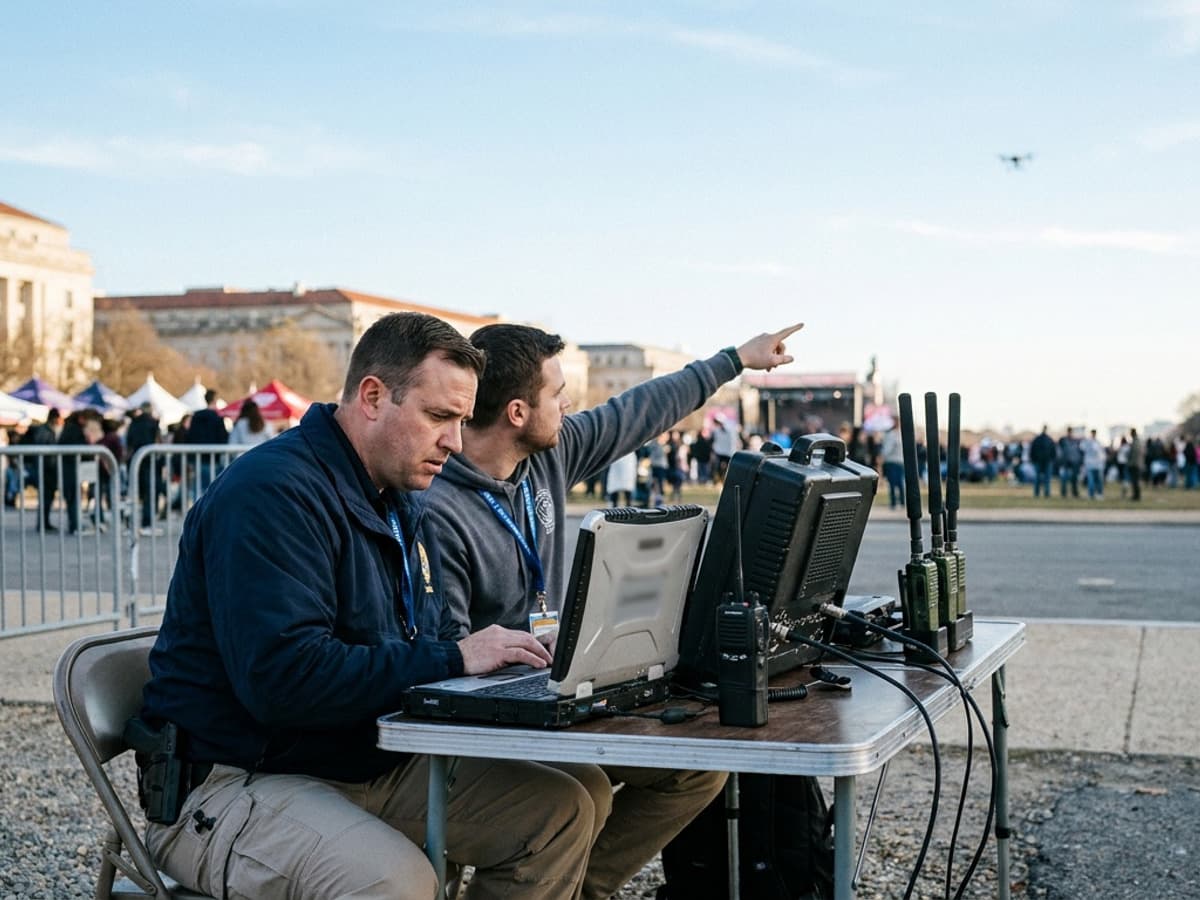
For drone pilots, the questions are what the money buys and who can use it. Radar, cameras, acoustic sensors, and Remote ID receivers are not subject to the notice's certification condition. Radio detectors that intercept or access a drone's control communications are. To buy them, staff need a Detection and Warning Certification from the FBI's National Counter-UAS Training Center (NCUTC), or must be enrolled in its training. Enrollment covers the purchase only, not operation. Only certified staff of an accredited police or correctional agency may run those systems. Mitigation equipment acts against a drone rather than just finding it. It must be hand-held or mounted on a vehicle. It must also be on the federal lists of approved technology. Certified staff of an accredited state, local, tribal, or territorial police or correctional agency may run it. So may a federal operation under a federal agency's supervision. Under the state and local authority, the notice says a mitigation action may be taken only by an officer or employee of an accredited agency who holds a current NCUTC Mitigation Certification and a valid FAA remote pilot certificate under Part 107.
The data
Grant-funded detection systems must share their data with DHS.
Every recipient or subrecipient that buys, leases, runs, or gets access to grant-funded detection systems or services must share relevant detection data with DHS "to support nationwide low-altitude air domain awareness." That covers detection events, tracks, Remote ID or other lawful identifier data, sensor metadata, and system status. It applies to what the system generates and the law allows. Separately, DHS "strongly encourages" grant recipients to buy active or passive radar. The notice says radio detectors generally depend on control signals, Remote ID, or other emissions. Radar can track a drone that is not broadcasting. FEMA lists longer-term targets and says they may be adjusted. One is to identify and classify 90% of detected drone threats, telling commercial, recreational, and possibly malicious flights apart. Another is to open criminal investigations on 100% of identified violations of civil and criminal laws. That means cases where operators endanger the public, break airspace rules, or use a drone in another crime. Under the American Security Drone Act, grant money cannot buy or operate drones made or assembled by a covered foreign entity.
Source file
Verify the reporting
Continue this beat
More public safety reporting
Rule watch · July 26, 2026
The new counter-drone authority for local police is narrower than the headlines suggest
Rule watch · September 29, 2026
Using a drone in a federal crime will add at least 4 levels to the sentencing range starting March 15, 2027
Safety · October 29, 2026