Justice Department opinion says police may detect drones and read Remote ID under federal wiretap law without counter-drone statutes
An Office of Legal Counsel opinion dated November 24 concludes that acoustic, camera, radar and radio-frequency drone detection generally does not violate the Pen-Trap Statute or the Wiretap Act. Intercepting other drone radio links must be judged case by case, it says.
By Joel Kelly

Decision brief
Your Remote ID broadcast is designed to be public. This opinion says federal, state and local officers can receive it under federal wiretap law without relying on a counter-drone statute. The opinion says the broadcast carries the drone's serial number, location, velocity and emergency status, plus the location of the control station or the takeoff location. The opinion addresses four categories of detection systems.
- Opinion
- Nov. 24, 2026
- Remote ID
- May be captured
- Other links
- Case by case
Office of Legal Counsel; released by the Justice Department on Nov. 25
Bluetooth and Wi-Fi broadcasts, without violating the Wiretap Act
Decoding them will often violate the Wiretap Act unless an exception applies
The opinion
Four kinds of detection, two federal statutes.
The Justice Department on November 25 released an Office of Legal Counsel opinion on drone-detection technology. The opinion is dated November 24 and signed by Assistant Attorney General T. Elliot Gaiser. It is addressed to the Counsel to the President. It concludes that four categories of detection systems "do not typically violate either the Pen-Trap Statute or the Wiretap Act." The four are acoustic, electro-optical and infrared, radar, and radiofrequency detection.
The effect
Detection without the counter-drone statutes.
The conclusion states what follows. Systems operating in the manner the opinion describes "may therefore be deployed by federal and SLTT agencies" without relying on the counter-drone statutes, it says. SLTT is the opinion's shorthand for state, local, tribal and territorial. Those statutes include 6 U.S.C. 124n. The opinion says they exempt authorized personnel from several criminal laws during counter-drone operations. It also says the statute covering state and local agencies limits the types of technology they may use.
Remote ID
A broadcast built to be received.
Remote ID gets its own section. The opinion says the FAA requires the broadcast on a non-proprietary specification, so that its contents are available to most personal wireless devices in range. Officials may capture Remote ID broadcasts sent by Bluetooth advertising or local Wi-Fi "without violating the Wiretap Act," it concludes. On the Fourth Amendment, it cites Brennan v. Dickson, a 2022 D.C. Circuit ruling. That court said drone pilots "generally lack any reasonable expectation of privacy in the location of their drone systems during flight."
The limit
Control links are judged case by case.
Other radio links are different. Whether intercepting them violates the Wiretap Act "must be determined on a case-by-case basis," the opinion says. Some systems decode the signals between a drone and its ground control station. Unless an exception applies, using them "will often violate the Wiretap Act," and officers would have to work within the counter-drone statutes. The opinion names DJI's Lightbridge and OcuSync as proprietary links that show "indicia of intended privacy." It says ExpressLRS, which relies on LoRa modulation and user-set parameters, is also not readily accessible to the public. A password or encryption has the same effect, it says.
Caveats
State law and FCC approval still apply.
The opinion carries limits of its own. It does not interpret state eavesdropping or pen-register laws. It says those laws may apply to state and local personnel acting outside 6 U.S.C. 124n. State, local, tribal and territorial law-enforcement agencies must obtain FCC approval before deploying any detection system that emits radio waves, it says. The opinion also notes that a 2020 federal advisory said monitoring the communications between a drone and its ground control station "may implicate" the Pen-Trap Statute. It says it now provides a fuller analysis.
Source file
Verify the reporting
- Justice Department: Justice Department Clarifies Lawful Use of Drone Detection Technologies to Protect Americans from Emerging UAS Threats (November 25, 2026)
- Office of Legal Counsel: Application of the Pen-Trap Statute and the Wiretap Act to Unmanned Aircraft System Detection Technologies (slip opinion, November 24, 2026, PDF)
Continue this beat
More public safety reporting
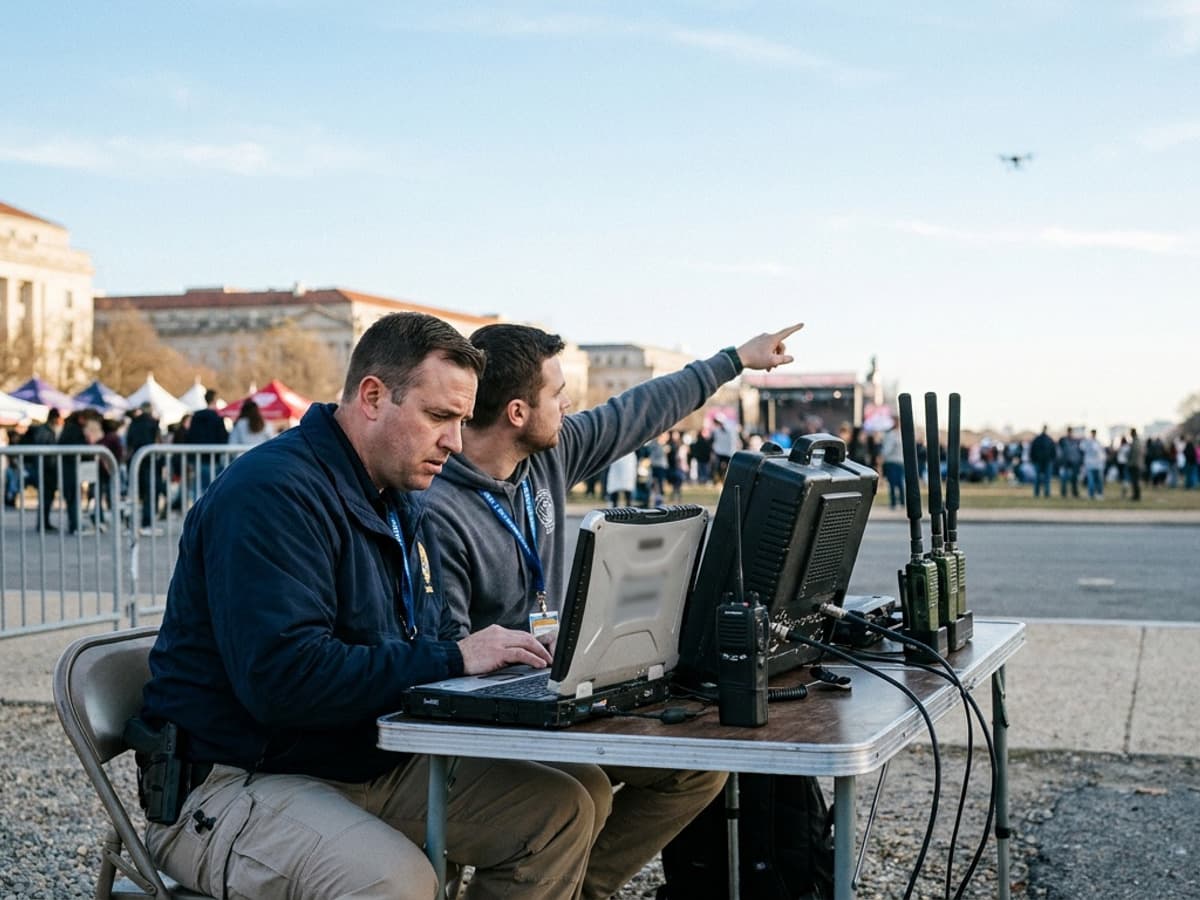
Rule watch · July 26, 2026
The new counter-drone authority for local police is narrower than the headlines suggest
Safety · November 10, 2026
Five federal departments announce a counter-drone agreement with FAA safety reviews of new systems
Safety · November 17, 2026