Drone Authority · Drone Laws
FPV rules: goggles, spotters, VLOS, and Remote ID (2026)
By Joel Kelly
Last updated September 26, 2026 · Facts verified against faa.gov. Rules change: confirm current requirements before you fly.
The short answer
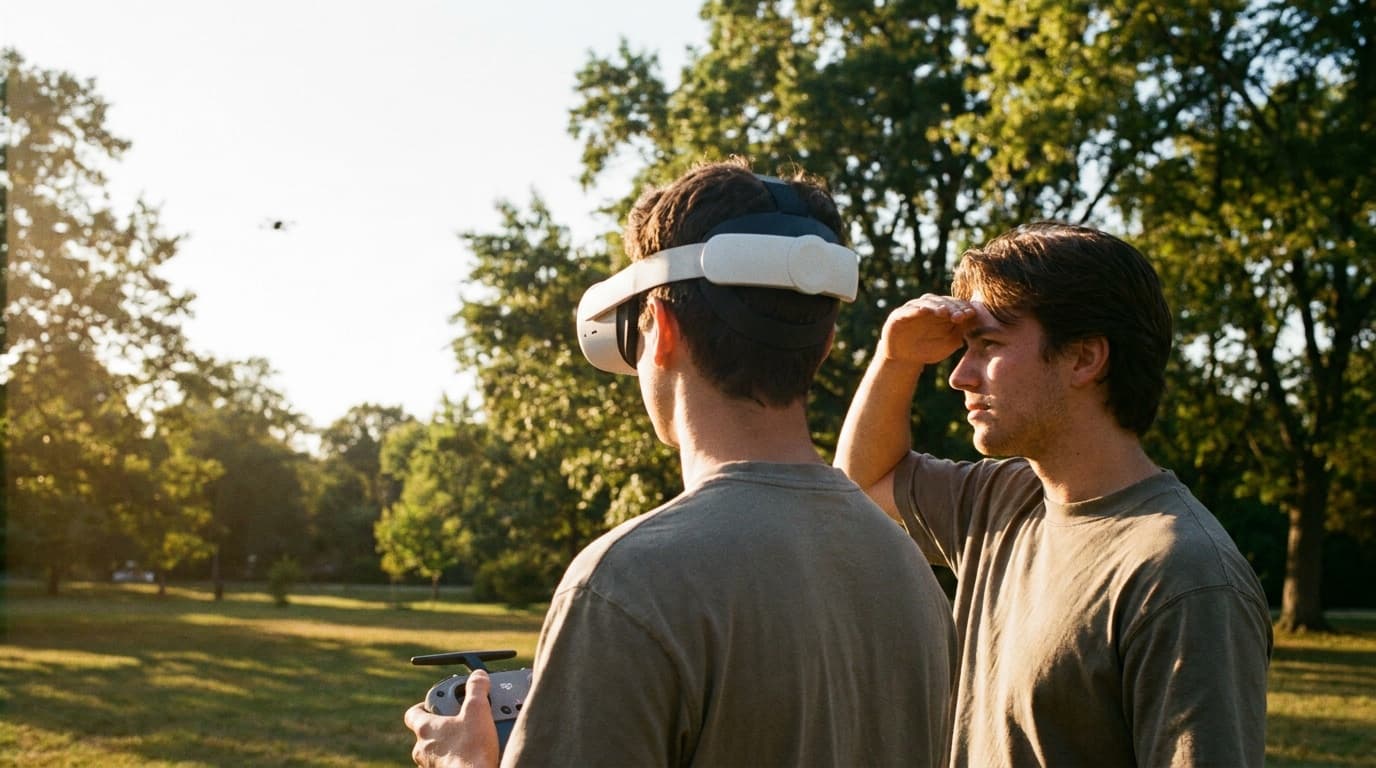
The spotter IS the legal architecture
Goggles don't suspend the visual-line-of-sight rules: a co-located visual observer satisfies them while your eyes are in the headset, under both the recreational exception and Part 107. Add three FPV-specific nuances (recreational sub-250g whoops skip registration and Remote ID, FRIAs exist for aircraft without broadcast modules, and indoor flying is outside FAA jurisdiction entirely) and you have the whole legal map most goggle pilots are missing.
VLOS with goggles on: how it actually works
- •Recreational (Section 44809): the exception's conditions include keeping the aircraft in visual line of sight: with goggles on, that means a visual observer alongside you maintaining unaided sight and communicating with you. Solo goggle sessions in the park don't strictly comply.
- •Part 107 (§107.31 + §107.33): the certificated route formalizes the same arrangement: a visual observer covers the see-the-aircraft duties while the remote pilot flies the camera. Commercial FPV shoots run this way as standard practice.
- •What the observer does: keeps unaided eyes on the aircraft and the sky around it, calls traffic and hazards, and can communicate instantly, which in practice means standing next to you, not down the ridge.
Registration and Remote ID, FPV edition
The clean recreational case: under 250 grams, flown for fun: no registration, and because Remote ID attaches to registered aircraft, no broadcast module either. Everything else needs both: heavier quads, and any aircraft flown for business purposes at any weight. Self-built 5-inch rigs over 250g register like anything else and need Remote ID: a broadcast module, or fly them at a FRIA (an FAA-Recognized Identification Area, typically a club field) where Remote ID isn't required. Full mechanics in our Remote ID explainer and registration guide.
The honest edges
- •Long-range: BVLOS is prohibited under both frameworks; there is no recreational long-range carve-out. The discipline exists in a compliance gray that every pilot should enter with open eyes, or keep flights inside unaided sight.
- •TRUST: required for recreational FPV like all recreational flying: free, online, once. Bring the certificate to the field.
- •Airspace: your bando, your park, your backyard: controlled airspace and LAANC apply to a whoop the same as a Mavic. Check before every new site.
- •Indoors: outside FAA jurisdiction entirely: the National Airspace System stops at the walls. The gym is the legal free-fly zone.
- •Flying for money: one monetized clip makes it commercial: Part 107, registration at any weight, Remote ID. Our license wizard sorts your exact case in five questions.
New to FPV entirely? The FPV hub sequences the whole path, starting in the simulator.
FPV rules: frequently asked questions
- Is it legal to fly FPV with goggles on?
- Yes, with a spotter. The FAA's visual-line-of-sight requirements don't go away because your eyes are in goggles: under the recreational exception you must use a co-located visual observer who keeps the aircraft in unaided sight, and under Part 107 the goggles-wearing remote pilot satisfies §107.31 by using a visual observer under §107.33. Solo goggle flying in open airspace, strictly read, doesn't comply with either framework: the buddy is the legal architecture.
- Does a visual observer have to stand next to me?
- Effectively yes. The observer must be able to see the aircraft unaided and communicate with you in real time: co-located is the practical and safe reading (recreational guidance says the observer is alongside the operator). Daisy-chaining observers down a mountain to extend range is not a legal workaround under either recreational rules or baseline Part 107.
- Do Tinywhoops need to be registered or broadcast Remote ID?
- Flown recreationally, a sub-250g whoop skips registration, and Remote ID attaches to registration, so an unregistered recreational whoop needs no Remote ID either. The catches: fly ANY drone for business purposes and it must be registered (and Remote ID equipped) regardless of weight, and airspace rules apply to a 25-gram whoop exactly as they do to a Mavic. Sub-250 is a paperwork exemption, not a legal force field.
- What is a FRIA and why do FPV pilots care?
- An FAA-Recognized Identification Area: a fixed flying site (typically a club field) where drones may fly without Remote ID. For FPV pilots with registered or self-built aircraft that lack Remote ID modules, FRIAs are the clean legal venue. They're tied to community-based organizations and educational institutions; find one near you through your local club or the FAA's data.
- Is long-range FPV legal in the US?
- Only to the edge of unaided sight. Beyond-visual-line-of-sight flight is prohibited under the recreational exception and baseline Part 107 alike: waivers exist but are enterprise-grade paperwork, and the pending Part 108 rule is aimed at commercial operations, not mountain surfing. U.S. long-range as practiced on YouTube frequently isn't compliant; know exactly which side of the line a flight sits on, because the pilot certificate at risk is yours.
- Can I fly FPV indoors without any of this?
- Yes, indoor flight is outside the FAA's jurisdiction (the rules govern the National Airspace System). No registration, no TRUST, no observer required in your living room or a rented gym. Property rules and common sense govern instead, which is one more reason indoor whoops are the perfect first real FPV aircraft.
Educational, not legal advice. FAA rules and interpretations change: verify current requirements at faa.gov before you fly.