SkyRover, Specta, Xtra and XAG could face a U.S. import and sales ban
A July 17 FCC notice proposes restricting previously authorized equipment tied to nine company groups. It is not final, and the agency has not issued a grounding order.
By Joel Kelly
What changed: Updated July 21 with the FCC docket, test-lab proceeding, and the proposal's stated treatment of already-purchased aircraft.

Decision brief
This is a proposed market restriction, not a company ban or a finding that every product is unlawful. If adopted, it would stop continued importation, advertising, distribution, and sale of the specified covered equipment. It would not make an already-purchased drone illegal to own or fly.
- Status
- Proposed
- Company groups
- 9
- Owner impact
- No grounding
No final market restriction yet
Specific equipment and related entities
Already-purchased equipment may keep operating
What happened
The FCC is targeting existing authorizations, not only future models.
The FCC opened a proceeding on July 17 that could remove already-authorized SkyRover, Specta, Xtra, XAG, and other covered equipment from normal U.S. retail channels. Public Notice DA-26-742 proposes limiting existing FCC authorizations so the specified equipment could no longer be imported or marketed. Under the notice, marketing includes advertising, distribution, and sale. This is a proposal in PS Docket 26-184, not a restriction already in effect.
The proposed scope covers equipment produced by nine company groups and their affiliates, subsidiaries, and other partners: Cogito Tech, Fikaxo Technology, Lyno Dynamics, Skyhigh Tech, Spatial Hover, SZ Knowact Robot, WaveGo Tech, Xtra Technology, and agricultural-drone maker XAG. Cogito markets Specta aircraft, SZ Knowact filings cover the SkyRover X1, and Xtra sells cameras. The notice identifies individual FCC IDs rather than declaring every product with any of those brand names prohibited.
The terminology
'Shell company' is shorthand. The FCC is testing a narrower equipment question.
The phrase 'shell company' is useful shorthand, but it is not the FCC's final legal finding. The notice uses terms including 'white-labeled devices,' 'exact hardware copies,' 'partner,' and technology-sharing or licensing relationships. It tentatively concludes that the listed equipment is covered and asks commenters to submit specific contrary evidence. Reporting calls some of the businesses DJI front or proxy companies; the FCC proceeding still has to decide what the record proves.
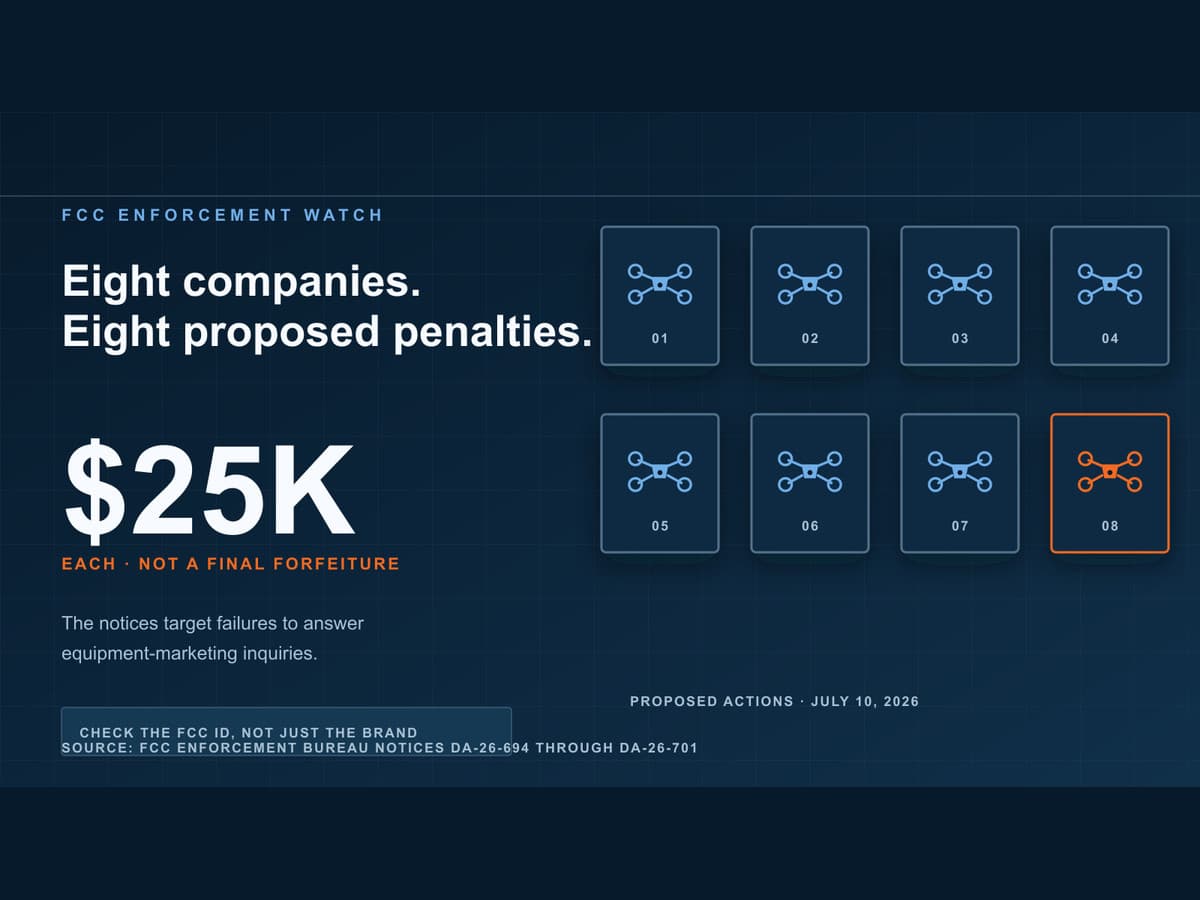
The FCC describes more than cosmetic similarity. It points to public analysis of shared proprietary communication protocols, FCC exhibits that retain branding or references tied to a Section 1709 company, SkyRover X1 radio-design similarities, and foreign-country origin statements. The eight companies from the July 10 enforcement round did not answer FCC letters of inquiry, and the agency temporarily deferred their grantee codes. XAG is a separate case: it responded to an inquiry, requested more time on two questions, and had its grantee code deferred after an agent-for-service issue.
Buyer and owner checklist
What to do while the proposal is pending
Separate the aircraft you already own from the market-access risk attached to a future purchase.
- 01
Already own one? Keep flying
The notice does not ground aircraft already in owners' hands. Normal FAA operating rules still apply.
- 02
Buying now? Check the FCC ID
Match the grantee, model, frequencies, and filing photos for the exact aircraft in the FCC equipment authorization database.
- 03
Confirm Remote ID separately
FCC authorization and FAA Remote ID compliance answer different questions. Verify the exact model in the FAA declaration database.
- 04
Want a say? File a comment
Use PS Docket 26-184. The deadline is 30 days after Federal Register publication, so confirm the posted calendar date first.
What it means
Owners are not grounded, a test lab is under review, and buyers need exact identifiers.
For current owners, the proposed line is unusually clear. The notice says a final restriction would not affect continued use or operation of already-purchased equipment. It also proposes exceptions for federal-government use and commercial testing or product development. That is why 'SkyRover could be banned' needs a qualifier: the contemplated action is a market-access restriction, not a grounding, confiscation, or remote deactivation order.
A separate July 20 order opened a proceeding that could withdraw FCC recognition from SGS-CSTC Standards Technical Services in Shenzhen, a laboratory used in some relevant equipment filings. A PRC-owned entity holds 15 percent of the lab and appoints three of ten board members. The lab argues that the stake does not confer actual control; the FCC says the applicable rule reaches ownership of 10 percent or more and has given the lab 35 days to respond before a final determination.
If you are shopping now, verify the exact FCC ID, grantee, model, frequencies, seller, and support path instead of treating a familiar-looking aircraft or a new brand name as proof of authorization. Check FAA Remote ID compliance separately. Comments may be filed in PS Docket 26-184; the notice says the deadline is 30 days after Federal Register publication, so use the live docket for the final calendar date rather than counting from the July 17 release.
Source file
Verify the reporting
- FCC Public Notice: proposed restrictions on specified covered UAS and equipment, DA-26-742 (July 17, 2026)
- FCC Order: proceeding on SGS-CSTC Shenzhen test-lab recognition, DA-26-744 (July 20, 2026)
- FCC docket 26-184: file a public comment (ECFS)
- The Verge: FCC proposal reaches SkyRover, Xtra, and other DJI-like equipment (July 20, 2026)
Continue on Drone Authority
Put the report to work
Continue this beat
More market reporting
Gear market · July 20, 2026
The FCC wants $25,000 each from eight drone companies that never answered its letters
Rule watch · September 12, 2026
The FCC's marketplace rule takes effect October 13. Drone listings on Amazon and eBay will have to carry a real FCC ID.
Rule watch · September 2, 2026