The short answer
Which goggles do I need?
If you fly a DJI drone, you need DJI goggles. There is no other option, because DJI's video link is closed. If you are building your own quad, you pick a video system first, then buy the goggles that receive it: Walksnail for the best all-around digital picture, HDZero for racing-grade latency, or cheap 5.8 GHz analog to find out whether you like the hobby before spending real money.
Decision one: the transmission system
FPV goggles are radio receivers with screens. The camera and video transmitter live in the aircraft, and the goggles have to speak the same protocol, which is why this decision comes first and locks in everything downstream. Four systems matter in 2026.
DJI O4 is the quality benchmark: a 1080p digital feed with latency around 30 ms and range that comfortably exceeds what you can legally use. The catch is the ecosystem. O4 only exists between DJI goggles and DJI aircraft or DJI O4 air units, and DJI goggles cannot receive anything else. You are buying into a closed system, and it is a very good one.
Walksnail Avatar is the answer for self-built quads: 1080p digital HD that lands just behind DJI on picture quality, with a low-latency mode around 22 ms. It works with any Betaflight build carrying a Walksnail VTX and camera, so it gives custom builders most of the DJI picture without the DJI lock-in.
HDZero takes the opposite trade. Its picture is 720p, noticeably softer than DJI or Walksnail, but its latency is fixed and sits under 15 ms, which is why racers favor it. It also degrades predictably instead of freezing, so you get warning before you lose the feed rather than a locked frame at the worst moment.
5.8 GHz analog is the original FPV link and still the cheapest ticket in. The picture is standard definition and full of static, but latency is a few milliseconds, parts cost almost nothing, and every brand's analog gear works with every other brand's. When an analog feed weakens you fly through snow rather than a freeze, which many pilots still consider a safety feature.
| System | Image quality | Latency | Ecosystem |
|---|---|---|---|
| DJI O4 (digital) | 1080p, the best picture in FPV | Roughly 30 ms, imperceptible for most flying | Closed. DJI goggles, DJI drones, and DJI O4 air units only |
| Walksnail Avatar (digital) | 1080p, close behind DJI | About 22 ms in low-latency mode | Semi-open. Any Betaflight quad with a Walksnail VTX and camera |
| HDZero (digital) | 720p, sharper than analog, softer than DJI | Under 15 ms, fixed and racing-grade | Open-leaning. HDZero VTX gear; goggles accept analog modules |
| 5.8 GHz analog | Standard definition with static and breakup | A few milliseconds, effectively instant | Fully open. Any analog VTX and camera from any brand |
Decision two: box LCD or binocular Micro-OLED
Once the signal arrives, it has to reach your eyes, and there are two very different ways to do that.
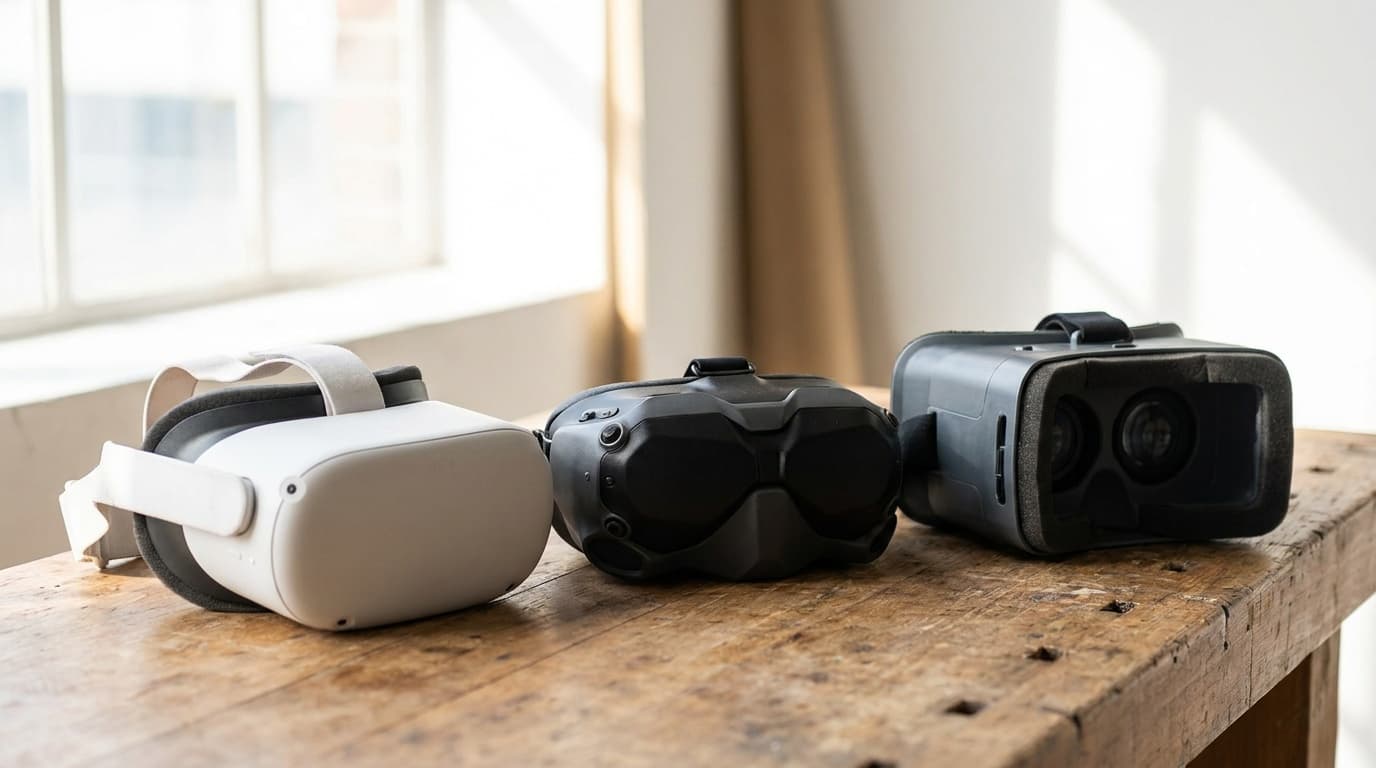
Box goggles put one LCD panel a few inches from your face inside a shroud, like a tiny private movie theater. They are bulky and less immersive, but they have two underrated advantages. They are cheap, and most fit over prescription glasses, so glasses wearers can fly without any extra optics. The budget Eachine EV800D and DJI's Goggles N3 both take this approach, which is why both work for glasses wearers out of the box.
Binocular goggles put a small Micro-OLED screen and a lens in front of each eye, like compact binoculars. The result is a sharper, higher-contrast, far more immersive picture in a slimmer headset. The trade-off is optics: there is no room for glasses inside, so you rely on built-in diopter adjustment. DJI's Goggles 3 and Walksnail's Goggles X both adjust from -6.0 to +2.0, which covers most common prescriptions, but pilots with strong astigmatism should check whether they need corrective lens inserts before buying.
Decision three: field of view and comfort
Field of view is how much of your vision the image fills. Binocular headsets in this class sit between roughly 44 and 54 degrees, and small differences matter more than the numbers suggest: 50 degrees feels immersive, while low-40s feels like a screen at the end of a hallway. Bigger is not automatically better. A wider image pushes detail toward the soft edges of the lenses, and some pilots find very wide views harder to read at race speed.
Comfort is the spec sheet's blind spot. Weight, faceplate shape, and light leak around the nose decide whether a headset disappears after ten minutes or gives you a headache. If you can try goggles on at a flying field before buying, do it. This is also where a club or group flight pays for itself; most FPV pilots will happily hand you their goggles for a battery's worth of flying.
Decision four: receiver modularity
The quiet spec that decides how long your goggles stay useful. Some headsets have a fixed, built-in receiver: DJI goggles receive DJI, full stop. Others take replaceable receiver modules or external inputs, so one headset can follow you across systems. Walksnail's Goggles X is the clearest example in our catalog: its receiver is modular and it accepts HDMI and AV input, so the same headset covers a Walksnail digital build, an old analog Tinywhoop through a module, and a simulator over HDMI. If you expect to own more than one kind of aircraft, modularity is worth paying for. If you are all-in on DJI, it is a feature you will never miss.
Which system pairs with which aircraft
The pairing rules are simple once you see them laid out.
- •DJI drones need DJI goggles. A Neo, Avata 2, Mini 4 Pro, or Air 3S only talks to DJI headsets. Goggles 3 or Goggles N3 are the choices; nothing else receives the feed.
- •Self-built quads choose their own system. A custom Betaflight build takes whatever VTX you install: Walksnail, HDZero, analog, or a DJI O4 air unit. Pick the video system before you pick parts, because the camera, VTX, and goggles must all match.
- •Analog gear is the universal fallback. Any analog quad works with any analog goggles from any brand, which is why a cheap box goggle is still the standard first headset for Tinywhoop pilots.
Use the FPV compatibility checker to test the video link beside the control link and battery system before checkout.
One rule applies no matter which column you land in. Under 14 CFR 107.31 and 107.33, and under the recreational rules, someone must keep the drone in unaided visual line of sight at all times. With goggles on, that someone cannot be you, so every goggle flight legally requires a visual observer standing next to you, watching the actual aircraft. Details and the rest of the rules live in our drone laws hub.
Where the four current headsets land
Run our catalog through those four decisions and each headset claims a distinct spot. Full ratings, specs, and current prices are on each review.
- DJI Goggles 3
The best picture in FPV: binocular Micro-OLED, O4 transmission, built-in diopters. The pick for DJI pilots who want the flagship experience, and closed to everything else.
- DJI Goggles N3
The budget door into DJI digital: one big LCD instead of dual Micro-OLED, the same O4 link, and room inside for glasses. The value pick for Neo and Avata 2 owners.
- Walksnail Avatar HD Goggles X
The builder's headset: digital HD near DJI quality, a modular receiver, and HDMI/AV input so one headset spans digital builds, analog quads, and the sim.
- Eachine EV800D
The classic analog box: standard-definition picture, diversity receiver, DVR, under $120. The cheapest honest way to find out whether FPV is your hobby.
FPV goggles: frequently asked questions
- Can I use DJI goggles with a self-built drone?
- Yes, but only by installing a DJI O4 air unit in the build. DJI goggles receive DJI transmission exclusively, so they will never work with Walksnail, HDZero, or analog video gear. If you want one headset that covers multiple systems, look at goggles with modular receivers and HDMI/AV input, like the Walksnail Avatar HD Goggles X.
- Are digital FPV goggles worth it over analog?
- For picture quality, absolutely: digital systems deliver 720p to 1080p HD against analog's static-filled standard definition. Analog still wins on price, near-zero latency, cross-brand compatibility, and graceful signal degradation, which is why it remains the standard starting point for Tinywhoop pilots and a budget headset like the Eachine EV800D still makes sense as a first purchase.
- Can I fly FPV goggles if I wear glasses?
- Yes, by one of two routes. Box-style goggles like the Eachine EV800D and DJI Goggles N3 fit over most prescription glasses. Binocular goggles like the DJI Goggles 3 and Walksnail Goggles X have no room for glasses but include diopter adjustment from -6.0 to +2.0, which covers most common prescriptions; strong astigmatism may require corrective lens inserts.
- Is it legal to fly a drone with FPV goggles?
- Yes, with a condition: FAA rules (14 CFR 107.31 and 107.33 for Part 107, plus the recreational rules) require the drone to stay within unaided visual line of sight. Since the goggles show the drone's camera view rather than the drone itself, a visual observer must stand with you and keep the aircraft in direct sight for the entire flight.
- What is the difference between DJI O4, Walksnail, and HDZero?
- All three are digital FPV transmission systems with different trade-offs. DJI O4 has the best image quality at 1080p with roughly 30 ms latency, but is locked to DJI hardware. Walksnail Avatar delivers 1080p at about 22 ms and works with any custom Betaflight build. HDZero trades resolution (720p) for fixed sub-15 ms latency, which makes it the racer's choice.
As an Amazon Associate we earn from qualifying purchases. FPV (goggle) flight requires a visual observer under 14 CFR 107.31/107.33 and recreational rules; see our drone laws hub before flying.