The short answer
What do I actually need?
If you fly a DJI drone, buy DJI batteries and the multi-battery charging hub for your model, store packs around half charge, and carry them on the plane, never in checked luggage. If you fly FPV, you also need a balance charger, a LiPo-safe bag or ammo can, and the discipline to put every pack back to storage voltage the same day you fly. That is ninety percent of battery ownership.
LiPo vs Li-ion: two chemistries, two personalities
Nearly every drone flies on one of two lithium chemistries. Lithium polymer (LiPo) cells come in soft foil pouches and are built to dump current fast. That burst power is why racing and freestyle quads use them, and it is also why they demand respect: the pouch can swell, and an abused LiPo can vent or catch fire. Lithium-ion (Li-ion) cells, usually cylindrical 18650 or 21700 cans, store more energy per gram but deliver it more gently. Long-range FPV builds use them for endurance, and most DJI smart batteries are lithium-ion or a hybrid chemistry tuned for energy density over burst current.
The practical takeaway: LiPo trades safety margin and lifespan for punch, Li-ion trades punch for range and tolerance. Neither chemistry forgives being punctured, overcharged, or fully discharged and left flat.
Cell counts: what 1S through 6S actually means
The S number is simply how many cells are wired in series. Each lithium cell sits at 3.7 volts nominal and 4.2 volts fully charged, so voltages stack: a 4S pack is 14.8 volts nominal, a 6S pack is 22.2. More voltage spins motors faster and moves the same power at lower current, which is why the FPV world has largely migrated from 4S to 6S for full-size quads.
| Cells | Voltage | What flies on it |
|---|---|---|
| 1S | 3.7 V nominal, 4.2 V charged | Tinywhoops and micro indoor quads |
| 2S-3S | 7.4 V to 11.1 V nominal | Toy-grade camera drones, light micro FPV builds |
| 4S | 14.8 V nominal, 16.8 V charged | The standard 5-inch freestyle FPV quad |
| 6S | 22.2 V nominal, 25.2 V charged | Modern 5-inch FPV builds, long-range and cinelifters |
Your motors, ESCs, and video gear are rated for a voltage range. Match the pack to the build; a 6S pack on 4S-rated electronics releases the magic smoke immediately.
C-ratings, honestly
The C-rating claims how much continuous current a pack can supply as a multiple of its capacity. The math is simple: a 1,300 mAh pack rated 100C should theoretically deliver 130 amps. The honest part is that marketing C-ratings are optimistic bordering on fictional, and everyone in the hobby knows it. A pack labeled 120C from a budget brand may sag like a real-world 60C pack from a good one.
What matters is voltage sag under load: a genuinely capable pack holds voltage through a full-throttle punch, a weak one dips so hard your quad falls out of the sky with capacity still in it. Buy from brands with a reputation to protect, read reviews that measure sag, and treat the printed number as a rough tier rather than a spec. For a 5-inch quad, a quality pack marketed at 95C to 150C is the normal range; past that the label is mostly ink.
Storage voltage, LiPo bags, and thermal runaway
Lithium cells hate sitting full and hate sitting empty. Storage voltage, about 3.8 volts per cell, is the happy middle, and every decent charger has a storage mode that brings packs there automatically. Leave a LiPo fully charged for weeks and it puffs and loses capacity; leave it flat and it may never safely charge again. The habit that separates long-lived packs from swollen ones is simple: charge on flying day, storage-charge the same evening.
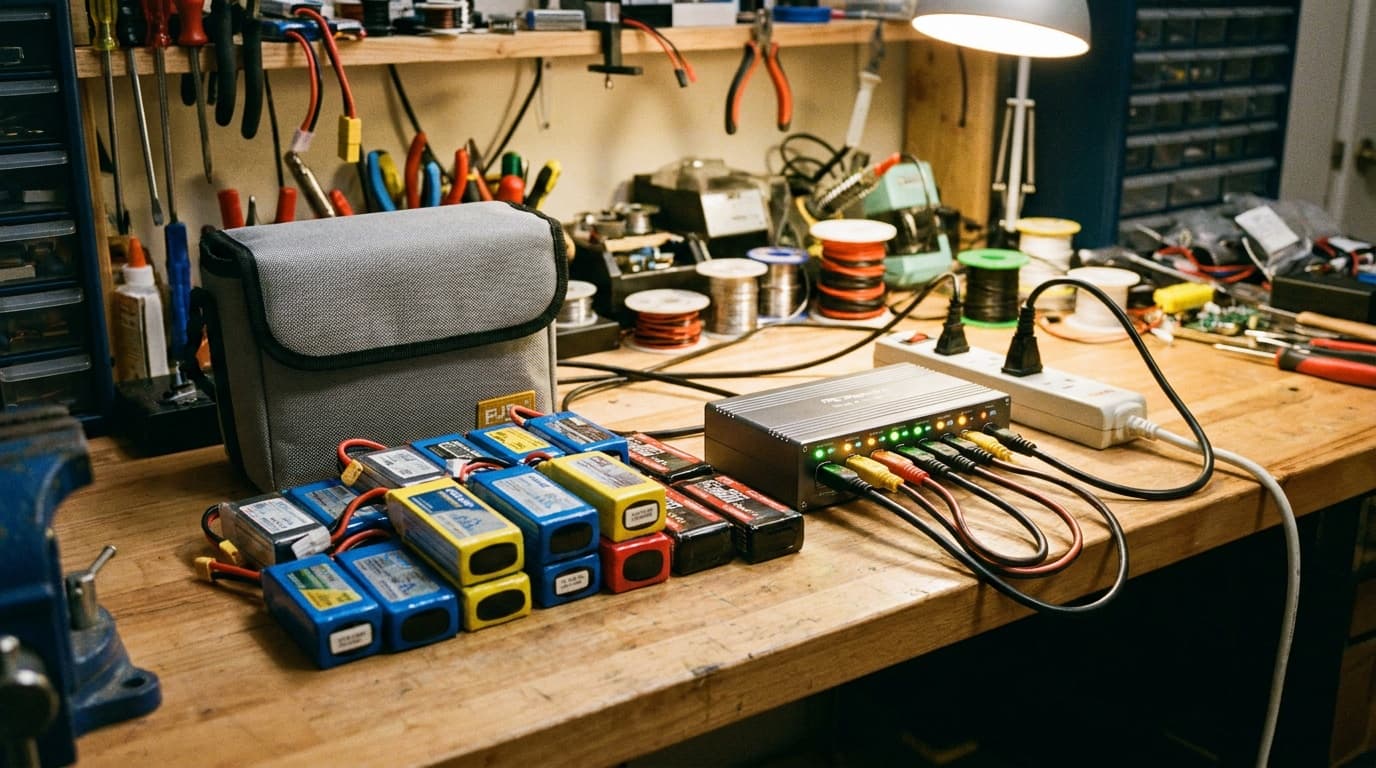
The failure mode to respect is thermal runaway. A damaged or overcharged cell heats itself, the heat accelerates the chemical reaction, and the pack vents hot gas and flame that water will not easily put out. This is rare and almost always traceable to abuse: a crashed pack put back on the charger, a puncture, a charger left unattended on the wrong setting. Charge inside a LiPo-safe charging bag or a metal ammo can with the gasket removed, on a surface that cannot burn, while you are in the room. Never charge a pack that is puffed, punctured, or still warm from a crash. Isolate a damaged pack on a noncombustible surface away from structures, do not puncture it, and follow local household hazardous-waste or battery recycler instructions for disposal.
DJI smart batteries vs hobby packs
DJI-style smart batteries wrap the cells in a hard case with a battery management system that balances cells, reports charge to the app, and self-discharges to storage level after a few idle days. They are nearly foolproof, and you pay for that: a smart pack costs several times what the raw cells would, and it only fits its own aircraft. Hobby packs are the opposite deal: bare cells, a main lead, and a balance lead, at a fraction of the price. All the management the smart pack does for you becomes your job, which is why the storage and charging habits above are not optional for FPV pilots. Neither type is better; they are different contracts about who does the thinking.
Chargers: balance charging and why dual chargers win
A hobby charger's core trick is balance charging: it monitors every cell through the small balance lead and nudges them to identical voltage, because a pack is only as healthy as its weakest cell. Any charger you buy should balance-charge, show per-cell voltages, and have a storage mode. AC-powered all-in-one units like the HOTA D6 Pro class or the classic ISDT and SkyRC lines cover almost everyone. The HOTA D6 Pro on Amazon is also available from GetFPV. Dual-channel chargers are worth the modest premium because charging two packs at once is the difference between flying all afternoon and watching a progress bar. DJI pilots should skip hobby chargers and use the official battery and hub for their exact model.
Flying commercial with batteries: the FAA and TSA rules
The rules for taking drone batteries on an airliner are strict and mostly about watt-hours. Spare lithium batteries, meaning any pack not installed in the drone, must travel in carry-on baggage, never checked. Under 100 Wh, which covers nearly every consumer drone pack, you can carry a reasonable number for personal use with no approval needed. Between 101 and 160 Wh, airline approval is required and you are limited to two spares. Over 160 Wh does not fly on a passenger aircraft at all.
Tape or cap the terminals, keep each pack in its own bag or case, and expect security to want them visible. Watt-hours are printed on smart batteries; for hobby packs, multiply nominal voltage by amp-hours. A 6S 1,300 mAh pack is about 29 Wh, and even a Mavic-class smart battery sits well under 100 Wh, so for most pilots the rule reduces to one sentence: everything goes in the carry-on.
For the exact watt-hours of your model's standard and Plus packs, use the drone battery airline check, which lists every battery the maker sells for 34 aircraft.
The sub-250 gram battery trap
One battery decision has legal consequences. Drones under 250 grams takeoff weight, like the DJI Mini series, are exempt from FAA registration for recreational flight. That weight is measured with the battery installed, and some manufacturers sell extended batteries that push the same aircraft over the line. A Mini flying on a heavier long-life pack can cross 250 grams, at which point it must be registered and, timing depending, carry Remote ID like any other drone. If you bought a sub-250 drone specifically for the exemption, check the all-up weight with the exact battery you fly, not the brochure number. The registration process and current rules live in our drone laws hub.
What to buy, by pilot
- •DJI pilots: buy official batteries and the hub made for your model. Third-party smart packs rarely justify the risk to the aircraft. Start with our model-by-model accessory guide.
- •5-inch FPV pilots: use a reputable 6S pack in the capacity and connector range specified by the quad. Our builder uses the exact CNHL two-pack on Amazon or the CNHL direct listing.
- •Tinywhoop pilots: match cell count, connector, capacity, and shaft hardware to the exact whoop. The Cetus path uses BT2.0 300mAh packs on Amazon or BETAFPV direct.
- •Everyone: add a charger with storage mode and a fire-resistant charging bag before the first loose LiPo enters the house.
Drone batteries: frequently asked questions
- Can I bring drone batteries on a plane?
- Yes, in carry-on baggage only. Spare lithium batteries are prohibited in checked luggage. Batteries under 100 Wh, which includes nearly all consumer drone packs, need no airline approval; 101 to 160 Wh packs require airline approval and are limited to two spares; anything over 160 Wh cannot fly on a passenger aircraft. Protect the terminals with tape or individual cases.
- What voltage should I store LiPo batteries at?
- About 3.8 volts per cell, which chargers call storage voltage or storage mode. Storing packs fully charged accelerates puffing and capacity loss, and storing them empty risks over-discharge damage. Best practice is to charge on the day you fly and return packs to storage voltage the same evening.
- Are higher C-rating batteries better?
- Only up to a point, and only if the number is honest. C-rating is claimed continuous discharge as a multiple of capacity, but marketing figures are widely inflated. Real-world voltage sag under load matters more than the label. Buy from reputable brands and treat the printed C-rating as a rough tier, not a measurement.
- Is it safe to charge a LiPo battery after a crash?
- Not until you have inspected it. A crashed pack with any puffing, dents, punctures, or a damaged lead should be retired, not recharged, because internal damage can trigger thermal runaway hours later. If the pack looks intact, let it cool completely, check per-cell voltages, and charge it inside a LiPo-safe bag while you are present.
- Will a bigger battery break my drone's sub-250g exemption?
- It can. The FAA's 250 gram threshold is measured at takeoff weight, battery included. Extended or third-party batteries can push a sub-250 drone like a DJI Mini over the limit, which means the aircraft must be registered for recreational flight and generally must comply with Remote ID. Weigh the drone with the exact battery you fly.
As an Amazon Associate we earn from qualifying purchases. Battery and travel rules change; confirm current FAA and TSA guidance before flying commercial, and see our drone laws hub for registration and Remote ID rules.